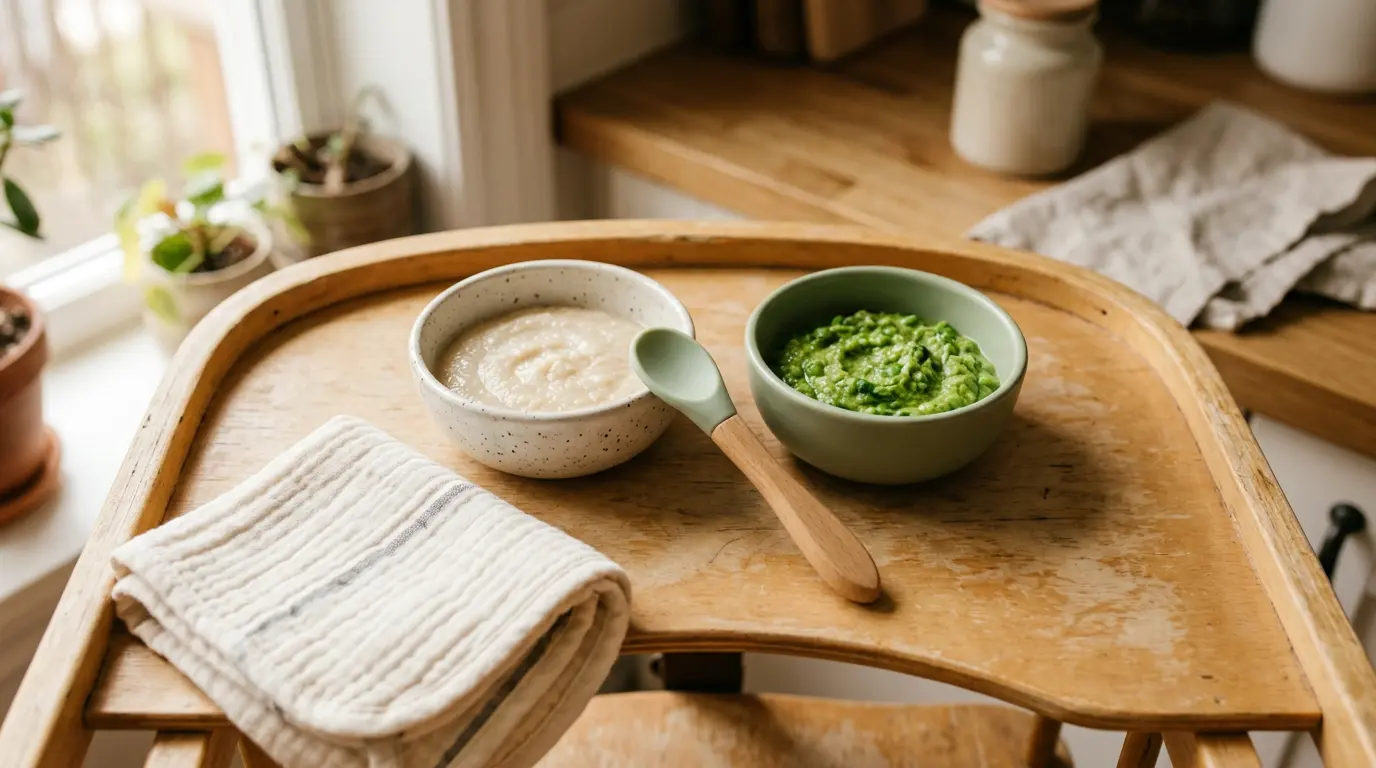
My oldest two are old enough now that I mix up which one did what first. But I remember starting solids twice, for two completely different reasons — and neither start date turned out to matter nearly as much as what happened in the weeks after. If you’re wondering when to start solid foods for your own baby, the honest answer from our house is: the date mattered less than what came next.
This post may contain affiliate links. If you make a purchase through these links, we may earn a commission at no extra cost to you.
This is general information based on common parenting practices, not medical advice. For any concerns specific to your baby, talk to your pediatrician.
Quick Verdict: There isn’t one correct starting age to read off a chart. When your baby is ready is a question for your pediatrician. With our two kids, the start date turned out to be the easy part — the real challenges showed up afterward.
Short answer: There’s no single correct starting age to read off a chart — when your baby is ready is a question for your pediatrician. Our own two kids started at different points, and the bigger challenges came after starting, not from the exact start date.
Last updated: September 21, 2026
Table of Contents
Why We Started at Different Ages
My oldest was exclusively breastfed, and we started solids once our pediatrician gave us the go-ahead. My second was formula-fed after weaning off breastmilk earlier, and we started a bit earlier than we had with her older sibling. At the time, that felt like it made sense — like formula-fed babies were supposed to start a little sooner.
Looking back, I never actually checked that assumption with our pediatrician at the time, and that’s the part I’d do differently. The earlier start with my second wasn’t based on any official rule. It was more a mix of what I’d picked up from other parents and a general sense that formula-fed babies “usually go a bit sooner.”
That’s the part I’d tell any first-time parent reading this and wondering when to start solid foods: don’t pick a date from a forum thread or a friend’s story. When your baby is ready is a question for your pediatrician — bring it up at a regular checkup and let that conversation set the timing.
The Timeline, Side by Side
Here’s roughly how the first few weeks looked for each of them, since the actual week-by-week reality is what most guides skip over.
| Stage | Oldest (breastfed) | Second (formula-fed) |
|---|---|---|
| First food | Rice cereal mixed into a thin puree | Rice cereal, same method |
| First 1–2 weeks | Cautious, small amounts — I was first-time nervous about every new texture | More relaxed pace, since I’d done this once already |
| Green vegetables introduced | Rejected consistently, made alongside a meat-based puree as backup | Same pattern — rejected, same backup method used |
| Biggest challenge | My own overcaution — double- and triple-checking textures | Preferred formula over solids for weeks, which turned into a longer struggle |
That’s not even the part most starting-solids guides get wrong. They talk about the first bite like it’s the hard part. For us, the first bite was the easy part both times — the actual difficulty showed up two to three weeks in, once the novelty wore off.
What Worked and What Didn’t
Starting with purees, rice cereal first, worked for us — but it wasn’t without trade-offs.
| Pros | Cons |
|---|---|
| Rice cereal mixed thin was gentle enough that neither kid had any reaction or refusal to the very first feeding | The double-batch method meant more dishes and more prep time every single feeding, which adds up fast when you’re already exhausted |
| Making two purees side by side — a vegetable and a backup — meant a rejected food never turned into a stressful standoff at the table | Being overly cautious with my first probably slowed things down more than it needed to — some of that caution wasn’t really necessary in hindsight |
| The slow, cautious pace with my first meant I caught her texture preferences early, which made the second time faster since I already knew what to expect |
The Two Problems That Actually Slowed Us Down
Green vegetables. Both kids rejected them, consistently, and I never got a clear answer on why — my guess is the slightly bitter edge that some greens have, but that’s a guess, not something I confirmed with a pediatrician. What actually worked was making two purees at once: a green vegetable and a meat-based one. If the green one got refused, I’d switch to the backup on the spot instead of pushing through a fight over broccoli.
The bigger problem was with my second. She strongly preferred formula over solids, and no matter how much I kept offering food, her formula intake just wasn’t dropping. It went on long enough that I actually brought it up at a pediatrician visit — not because anything seemed medically wrong, but because I wanted a second opinion on whether I was pushing too hard or not hard enough.
What actually moved things forward was gradually cutting formula in small amounts and timing solids for when she was genuinely hungry, using flavors she already liked. Once solids showed up right at the hunger window instead of competing with a full bottle, the balance started shifting. It wasn’t fast, and it wasn’t a single fix — it was weeks of small adjustments before formula intake actually came down.
What I’ll Watch For With the Twins
Both of my older kids started solids long enough ago that a lot of the fine details have faded — which is honestly a fair warning to any parent reading this: write things down if you want to remember them later, because I didn’t, and now I’m relying on scattered memory for a lot of this.
With the twins, starting solids is still ahead of us, and I’m expecting a version of the same two issues — some rejected food, and possibly two different paces if one twin takes to it faster than the other. If anything changes meaningfully once we’re actually in it, that’s the kind of update this post will get, not a rewrite from scratch.
Frequently Asked Questions
Is it true that formula-fed babies should start solids earlier than breastfed babies?
That’s what I assumed with my second, and it came from other parents, not from our pediatrician. It’s worth asking your pediatrician directly rather than going by what you hear — when your baby is ready is a question for them, whatever the feeding method.
Why do so many babies reject green vegetables specifically?
We don’t have a confirmed answer for this — some greens do have a more bitter edge, which is a common guess, but we didn’t get this checked by a pediatrician. Making a backup puree alongside the rejected food is what worked for us, rather than trying to force it through.
How long does it typically take to reduce formula intake once solids start?
For us, it took weeks of gradual adjustment, not days. If a baby strongly prefers formula over solids for an extended period, it’s worth raising with a pediatrician rather than assuming it will resolve on its own.
Do you need to introduce foods in a specific order?
We started with rice cereal both times, which is a common traditional first food, but this wasn’t based on a strict rule we researched — it’s simply what we did. Talk to your pediatrician about first-food choices for your baby specifically.
Summary
When to start solid foods mattered less than we expected going in — both kids did fine, even though they started at different points. What actually took real effort was working through green-vegetable rejection and, with my second, a formula-over-solids stretch that took weeks of small adjustments to shift. If you’re about to start this with your own baby, the timing conversation belongs with your pediatrician — and it’s worth deciding early how you’ll handle food refusal, because it’s likely to come up.
How We Put This Together
Personally tested: this is our own family’s experience starting solids with two kids; no products are reviewed here. The timeline and challenges described here come from our own family’s experience with two kids. Questions about when your own baby is ready to start belong with your pediatrician.
For the full list of feeding gear, from the high chair to the spoon, see our starting solids checklist. If you’re picking dishes, our suction plate vs suction bowl comparison covers which one to buy first.
Written by Four Kids Dad, parent of four kids including newborn twins. More about how we work is on the About page.
Leave a Reply