This post may contain affiliate links. If you make a purchase through these links, we may earn a commission at no extra cost to you.
This is general information based on common parenting practices, not safety certification advice. Always follow your specific car seat’s manual, and consider a check by a certified Child Passenger Safety Technician if you’re unsure about fit or installation.
Quick Verdict: You don’t need an infant car seat — a convertible seat can be used from birth if it fits your newborn correctly and the manufacturer allows newborn use. Choose an infant seat if portability and stroller compatibility matter to you. Choose a convertible if you want one seat to last for years instead of months.
Direct answer: In an infant vs convertible car seat decision, switch when your child reaches the seat’s specific height or weight limit — not at a fixed age. Age ranges you’ll see online are a rough reference point at best; your seat’s manual is the actual authority.
Last updated: September 20, 2026
Table of Contents
What Is a Convertible Car Seat?
A convertible car seat starts out rear-facing and later converts to forward-facing, so a single seat covers more than one stage. According to NHTSA, convertible seats typically have higher rear-facing height and weight limits than infant-only seats, which lets a child stay rear-facing for a longer period.
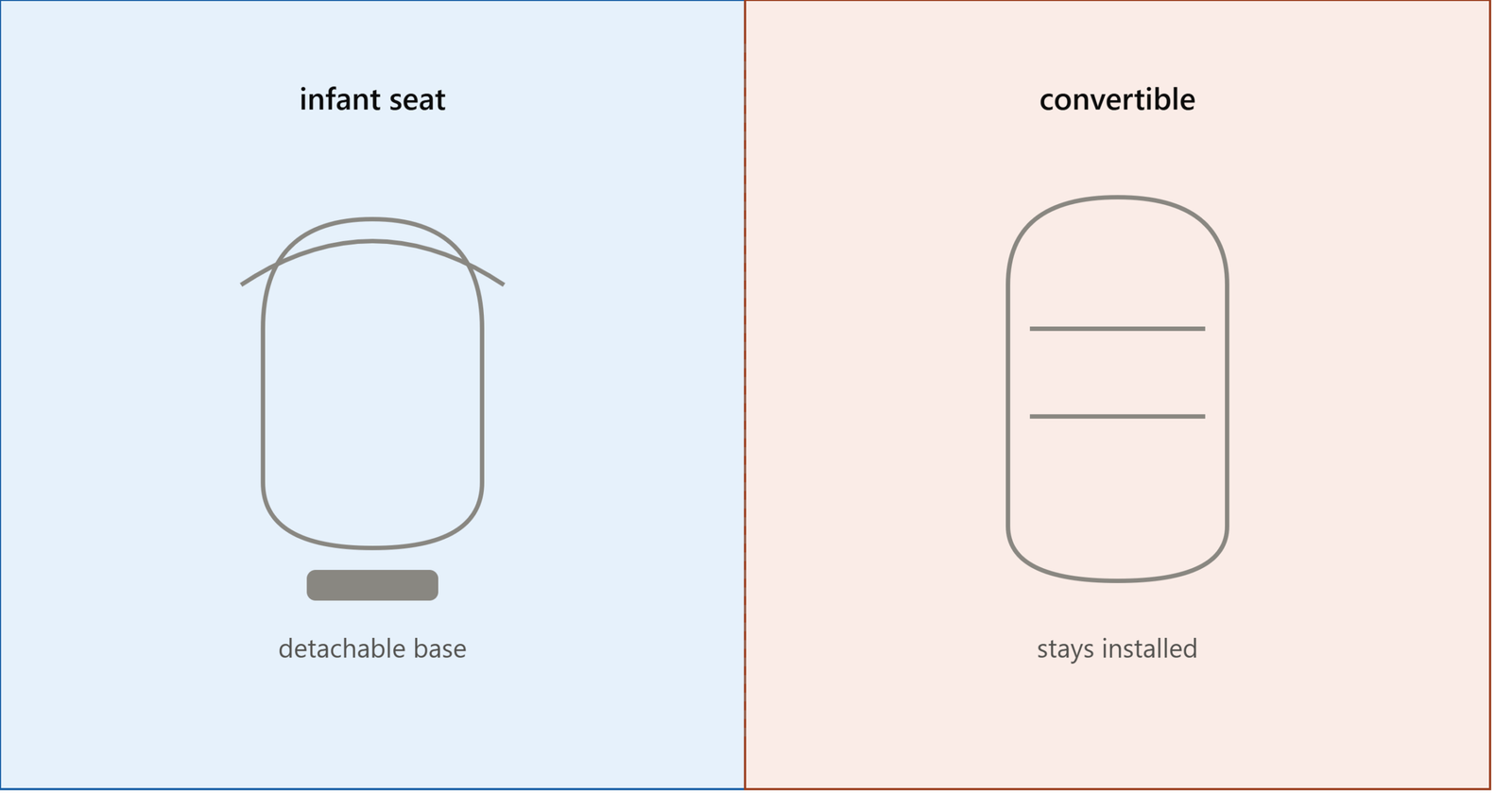
The one-line difference: an infant car seat is rear-facing only and clicks in and out of a detachable base, while a convertible car seat stays installed in the car.
The Real Difference Between Infant and Convertible Car Seats
Every registry list has this fight built in: infant seat first, or skip straight to convertible? Both camps are loud about it, and both are right for different situations — which isn’t a satisfying answer, but it’s the honest one for an infant vs convertible car seat decision.
Both are rear-facing at the start. The real difference is in how long each one lasts and how it’s used day to day.
| Feature | Infant car seat | Convertible car seat |
|---|---|---|
| Orientation | Rear-facing only | Rear-facing, then forward-facing later |
| Base | Detachable base — carry the seat in and out of the car | Installed directly in the vehicle; baby is buckled in and out each time |
| Height and weight limits | Set by each model — for example, UPPAbaby lists its Aria V2 at 4–30 lbs and up to 30″ | Set by each model; NHTSA notes convertible seats typically have higher rear-facing limits than infant-only seats |
| How long it lasts | Until your child reaches that model’s height or weight limit | Until your child reaches that model’s rear- and forward-facing limits |
| Stroller travel-system compatibility | Common — many click into matching strollers | Not typically designed for this |
The Easiest Way to Choose
Don’t start by asking which seat type is “better.” Start by asking how you actually use your car day to day — that answers an infant vs convertible car seat question faster than any spec sheet.
| If you… | Better starting point |
|---|---|
| Carry your baby in and out of the car often (errands, drop-offs) | Infant seat |
| Use a stroller travel system frequently | Infant seat |
| Want one seat to last for years instead of buying twice | Convertible seat |
| Rarely remove the seat from the car | Convertible seat |
| Want the longest possible rear-facing duration | Convertible seat |
| Have twins or two newborns close in age | Depends on your vehicle’s back-seat width and budget for two seats — worth checking fit before deciding |
That’s not even the part most comparison posts get wrong. They frame this as infant-seat-vs-convertible on the seat’s merits, when the actual deciding factor is usually your own routine — how often the seat leaves the car, not which one has better specs on paper.
Infant Car Seats: What You Actually Get
The detachable base is the entire pitch of an infant seat. You buckle your baby in at home, click the seat into the base at the car, and don’t have to wake or rebuckle a sleeping baby to go somewhere.
| Pros | Cons |
|---|---|
| Detachable base means you can move a sleeping baby from car to stroller without unbuckling them | Shorter lifespan than a convertible — it’s outgrown once your child reaches the model’s height or weight limit |
| Many are designed to fit newborns and smaller babies more snugly than a convertible seat’s built-in inserts | You’ll need to buy a second seat (a convertible) regardless, so an infant seat is an added cost on top of what you’ll eventually need anyway |
| Lighter and more portable for quick errands, since you’re carrying the seat itself, not maneuvering a toddler in and out of a fixed seat |
Pro-tip: Check your specific infant seat’s height limit before you buy, not just the weight limit. Your seat’s manual spells out both limits and its own fit check, and those are what decide the switch.
Convertible Car Seats: What You Actually Get
A convertible seat skips the short first chapter and takes a child from newborn through toddler, sometimes preschool age, depending on the model.
| Pros | Cons |
|---|---|
| One seat covers years instead of months — many models extend rear-facing limits well past what an infant seat allows, keeping a child rear-facing longer, which NHTSA points to as a reason to choose them | No detachable base — every time you leave the car, your child comes out of the seat, and you carry them, not the seat |
| No need to buy a second seat later, which can offset the higher upfront cost over time | Bulkier and heavier overall, which some parents find less convenient for quick in-and-out trips compared to an infant seat |
| Higher weight and height ceilings overall, since these seats are built to grow with the child through both rear- and forward-facing stages |
When to Actually Switch — Fit First, Age as a Rough Reference Only
Don’t switch simply because your baby reaches a certain age. Age ranges you’ll see online are a loose average at best — the limits that matter are the ones your seat’s manufacturer lists.
| Priority | What to Check |
|---|---|
| 1. Height and weight limits | The numbers in your specific seat’s manual, not a category-wide average |
| 2. Physical fit check | Your manual’s own fit rules, such as head clearance and harness position — the exact wording differs by brand |
| 3. Age | Useful only as a rough heads-up that a check is probably due soon, not as the actual trigger |
A convertible seat can be used from birth when the manufacturer allows newborn use and the baby fits the seat’s inserts correctly — and NHTSA‘s guidance is to keep a child rear-facing until they reach the top height or weight limit allowed by the seat’s manufacturer.
Model differences matter here too. UPPAbaby’s Aria V2 infant seat is listed at 4–30 lbs and up to 30 inches, while their Mesa V3 lists the same weight range with a height limit of up to 32 inches — a two-inch gap that could matter for a taller baby. Check your specific model’s numbers rather than assuming from the category.
Frequently Asked Questions
Infant car seat vs convertible car seat: which first?
Either can come first — it depends on your routine, not a date. An infant seat first suits families who move a sleeping baby between car and stroller often. A convertible first can mean buying one seat instead of two, as long as the manufacturer allows use from birth and it fits your newborn. Either way, NHTSA’s guidance is to keep a child rear-facing until the top height or weight limit allowed by the seat’s manufacturer.
Do you really need an infant car seat?
No. A convertible seat can be used from birth if the manufacturer permits newborn use and the seat fits your baby correctly. The infant seat’s main advantage is the detachable base, not a safety requirement.
Can a newborn use a convertible car seat?
Generally yes, for models designed to accommodate newborns, often with the help of an infant insert. Check your specific seat’s minimum weight and the fit of the harness and headrest before using it with a very small baby.
When should you stop using an infant car seat?
When your child reaches the seat’s listed height or weight limit, or when a fit check shows minimal space left above the head — check your specific seat’s manual for its exact fit criteria rather than relying on age alone.
Is a convertible car seat safer than an infant seat?
Neither category is inherently safer — both must meet the same federal safety standards. The safety difference in practice comes from correct fit and installation, and from how long a child stays rear-facing, which NHTSA notes convertible seats typically support for longer.
What should I do if my baby outgrows the infant seat?
Move to a convertible seat in the rear-facing position, and keep them rear-facing until they reach the top rear-facing height or weight limit allowed by that seat’s manufacturer, per NHTSA’s guidance.
Final Verdict
Neither seat type is objectively better in an infant vs convertible car seat decision — they’re built for different trade-offs. If you carry your baby in and out of the car often or lean on a stroller travel system, start with an infant seat. If you’d rather buy one seat and be done, or rarely take the seat out of the car, a convertible from birth is a reasonable choice.
Before you buy either, pull up the specific model’s height and weight limits and compare them against your actual routine from the table above — not just the spec sheet. Check current listings and specific model numbers directly before deciding, since limits vary meaningfully even within the same brand.
How We Researched This
Researched: Height and weight figures are quoted only from manufacturers’ published specifications (UPPAbaby’s Aria V2 and Mesa V3 product pages, checked September 2026) and from NHTSA’s car seat guidance. Always confirm against your own seat’s manual, since limits vary by model and change between generations.
Once you’re past the infant seat, fitting the next seats is its own puzzle — we covered two rotating car seats in captain’s chairs and three car seats across a sedan separately.
Fitting several seats in one row? Our 3 car seats across guide covers how different seat types share the space.
Written by Four Kids Dad, parent of four kids including newborn twins. More about how we work is on the About page.
Leave a Reply