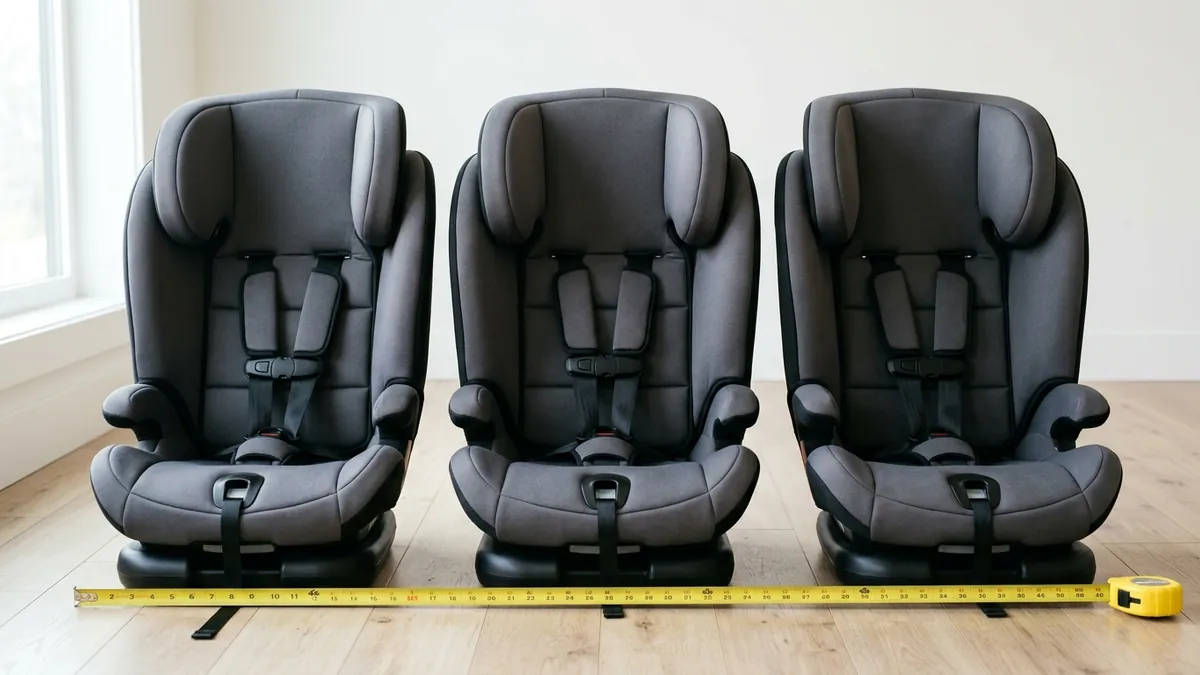
This guide is general product research, not a substitute for a car seat inspection. Follow your car seat’s manual and your vehicle owner’s manual for every installation, and have your setup checked by a certified technician.
Last updated: September 27, 2026
Fitting 3 car seats across one row is less about finding a magic car seat and more about solving a puzzle in the right order. Measure first, match seats to the space, then pick an installation method seat by seat. The step most people skip is the one that decides whether the buckles still work when you’re done — and it’s in section 4.
Short answer: You can often fit 3 car seats across by measuring the usable width at the seat cushion, choosing narrower seats where the space is tight, installing each seat with either the lower anchors or the seat belt (not both), and checking that every buckle is still reachable. If the row has captain’s chairs, three across isn’t possible in that row.
| Vehicle setup | What tends to limit 3 across | Check first | Deep-dive guide |
|---|---|---|---|
| Sedan | Narrower rear bench, door curves, head restraints | Usable width at the cushion | Sedan fit guide |
| 3-row SUV with a bench | Listed hip room vs space you can actually use | Which second row your trim has | Grand Highlander guide |
| Minivan or SUV with captain’s chairs | Only two seats in that row | Third-row seating and anchors | Captain’s chairs guide |
| Any vehicle, seats already in | Buried buckles between seats | Buckle access for each seat | Buckle guide |
| Mixed ages (infant, convertible, booster) | Different widths and install methods | Which seat type each child uses | Infant vs convertible |
Table of Contents
1. Measure the Row for 3 Car Seats Across, Not the Car
Every attempt at 3 car seats across starts with a number, and the number most people reach for first is the wrong one. Spec sheets list hip room or shoulder room — measurements of the cabin, not of the flat part of the seat where a car seat base actually sits. Door panels curve inward, armrests stick out, and the cushion itself is often narrower than the space above it. Our Grand Highlander guide walks through why a big hip-room figure can still leave you short once you measure at cushion level.
So measure it yourself. Run a tape across the seat cushion from door panel to door panel, at the height where a car seat’s base would rest. Then measure again a little higher, where the widest part of a car seat shell sits. Those two numbers — cushion width and shell-height width — tell you more about 3 car seats across than any brochure.
While the tape is out, note three more things:
Buckle positions. Where each seat belt buckle comes up from the cushion, and whether the center buckles sit close together. Buckles that are bunched in the middle are the first thing to disappear under three car seats.
Anchor locations. Where the lower anchors are, and whether the center seat has its own set. Your vehicle owner’s manual lists which seating positions have lower anchors and which have top tether anchors.
Head restraints and seat contours. A raised center hump, a fold-down armrest, or a head restraint that won’t lower can all push a seat out of position.
The center position itself. Some center seats are raised, narrower, or shaped differently from the outboard seats. Your vehicle owner’s manual says whether the center position can be used for a car seat at all, and with which installation method. That single answer can decide whether a three-seat row is even possible before you measure anything else.
Write it all down. It feels like overkill until you’re standing in a store aisle comparing listed widths, and then —
Well. Then those numbers are the only thing that matters.
If you drive a sedan, our sedan fit guide covers the extra limits a smaller rear bench adds, including door curvature and how little room is left once the outer seats are in.
2. Know Which Seats You’re Fitting
A family trying to fit 3 car seats across often isn’t fitting three identical seats. More often it’s a mix — an infant seat, a convertible, a booster — and each type takes up space differently. Before buying anything new, list which kind of seat each child is in today and which kind they’ll move to next, based on the height and weight limits in each seat’s manual.
Infant seats
Infant seats are rear-facing only and click into a base. The base and the carrier handle both take up room, and the handle position during travel is set by the manufacturer, so check the manual before assuming it can be moved out of the way. If you’re deciding whether to use an infant seat at all, our infant vs convertible car seat guide covers that choice, including what NHTSA says about keeping a child rear-facing until the manufacturer’s limits.
Convertible and all-in-one seats
These are the seats where listed width matters most, because some manufacturers design specific models around 3-across installs. Clek lists its Fllo convertible at a seating width of 16.9 inches and describes it as purpose-built for 3-across installations. Graco lists its SlimFit3 LX at 16.7 inches wide.
There’s a detail in Graco’s wording worth noticing. The same page says the seat fits 3 car seats across the back seat “with select other Graco car seats.” That’s an honest qualifier, and it points to something every narrow-seat claim quietly assumes: a specific combination of seats, in a specific vehicle. A listed width tells you how wide one seat is; it doesn’t tell you whether three seats fit in your row.
Boosters
Boosters can be narrower than harnessed seats, but they bring their own problem: the child uses the vehicle seat belt, so the buckle has to stay reachable for the child or an adult every trip. A booster that fits but buries its own buckle hasn’t really solved 3 car seats across. Section 4 covers that.
Before buying a new seat to make 3 car seats across work, run through a short list. Does the listed width come from the manufacturer’s own product page, not a third-party roundup? Is that width measured at the widest point of the seat, or only at the base? Does the manufacturer say anything about which vehicles or seat combinations the 3-across claim assumes? And can you return the seat if it doesn’t fit your row? A seat that’s narrow on paper but can’t be returned is an expensive experiment.
Depth matters too, not just width. A rear-facing seat takes up front-to-back space, and in some vehicles that can affect how far the front seat in front of it can slide back. It’s not the main constraint for three across, but it’s worth checking with the seats installed, especially if a tall adult sits in front of a rear-facing seat.
The practical takeaway: plan the row around the widest seat you’ll need, not the narrowest one you own today. Children move between seat types, and a row that works this month may not work after the next switch.
3. Choose the Installation Method Seat by Seat
Each car seat in the row can be installed one of two main ways, and the choice changes where the seat sits. NHTSA’s car seat guidance says every car seat needs to be installed using either the lower anchors or the seat belt — not both — and that if you use the seat belt, you should lock it the way your vehicle owner’s manual describes. For a forward-facing seat, NHTSA’s guidance also covers using the top tether where available.
Why this matters for 3 car seats across: lower anchors are in fixed positions. If the center seat has no lower anchors of its own, or if two sets of anchors would force two seats to overlap, the seat belt may be the way to position a seat where it actually fits. Switching one seat from anchors to the seat belt can shift it just far enough to make the row work — as long as both manuals allow that position and method.
Here’s a hypothetical to show how that plays out. Picture a bench where only the two outer positions have lower anchors. A rear-facing convertible goes in first, using the outer anchors on one side. The center seat has no anchors of its own, so it goes in with the seat belt, locked as the vehicle manual describes. The third seat takes the remaining outer anchors — or, if that pushes it into the center seat, the seat belt instead. Nothing about that sequence is universal; it’s an example of why the method is chosen seat by seat, not for the whole row at once.
A few rules of thumb hold regardless of vehicle:
Read both manuals. NHTSA’s guidance is to follow the car seat manufacturer’s instructions and read the vehicle owner’s manual for installation. The vehicle manual says which positions have anchors and whether anchors can be borrowed from neighboring positions; the car seat manual says whether that’s allowed for that seat.
Check whether seats may touch. Three seats in one row often end up pressed against each other. Whether that’s acceptable is set by each car seat manufacturer, so it’s worth checking each manual rather than assuming.
Install the hardest seat first. That’s the seat with the least flexibility — for example, a rear-facing seat or one that must use a specific position. Get it right, then fit the others around it.
We can’t tell you which method will work for your specific combination. That depends on the exact seats, the exact vehicle, and sometimes the exact trim. It’s the part of 3 car seats across where hands-on trial and a second opinion are worth more than any guide.
4. Plan the Order and the Buckles
This is the step from the intro. A row can technically hold three seats and still fail every morning if nobody can reach the buckles.
Harnessed seats are installed once and then buckle the child into the seat’s own harness, so the vehicle buckle matters mostly during installation. Boosters are different: the child uses the vehicle belt every ride, so the vehicle buckle for that position has to stay reachable with the seats in place. That’s why the order of seats across the row matters as much as their widths. Putting the booster where its buckle is easiest to reach can be the difference between a row that works and one that doesn’t.
Our guide on how to buckle car seats that sit too close together goes deeper, including why seat belt extenders aren’t the fix and how to pre-route belts before installing tightly packed seats.
Before committing to a layout, run a dry test: install all three seats, then buckle every seat and every booster belt the way you would on a normal morning. If any buckle needs two hands and a flashlight, it’ll get skipped sooner or later. Rearrange and try again.
Think about the daily routine, too. Which child gets in first, from which door? If the middle seat belongs to the child who needs the most help, you’ll be reaching across an outer seat every time. With twins or two children close in age, it can help to put the seat that needs the most adult hands on the side of the car you usually load from, and the most independent child in the spot that’s easiest to climb into. A 3 car seats across layout that looks perfect on the driveway can still be the wrong one at 7:30 on a school morning.
One more thing to watch for: a seat that fits tightly can put pressure on a neighboring seat’s buckle or belt path. That’s another reason to have the finished row checked rather than trusting that a tight fit is a good fit.
5. When the Row Has Captain’s Chairs
Some three-row vehicles come with two captain’s chairs in the second row instead of a bench. In that row, 3 car seats across isn’t possible — there are only two seats. The question becomes where the third car seat goes.
Usually that means the third row, which brings its own checks: whether the third-row positions have lower anchors or top tether anchors, whether an adult can reach a child back there to buckle them in, and whether the seat you want to use there fits behind the captain’s chairs. The vehicle owner’s manual lists anchor locations by row.
Captain’s chairs do open up one option a bench doesn’t: rotating car seats that swivel toward the door. Two of them side by side can collide when turned, which our guide to two rotating car seats in captain’s chairs covers in detail.
Reach matters in the third row as well. Buckling a child into a third-row seat usually means climbing in or leaning over the second row, and a child who needs help with every buckle may be better placed in the second row, with a more independent child in the back. Check, too, whether the second-row captain’s chairs need to slide or tilt for third-row access — and whether that still works with car seats installed in them.
If you’re still shopping for a vehicle, the second-row configuration is worth checking on the exact trim before you buy. Two vehicles with the same name can have a bench in one trim and captain’s chairs in another, and that single difference decides whether 3 car seats across in the second row is even on the table.
6. Get the Finished Row Checked
Every guide about 3 car seats across, including this one, ends in the same place: a certified technician looking at your actual seats in your actual vehicle. NHTSA’s car seat page offers a way to find an inspection station by zip code or city, and says certified technicians will inspect your car seat free of charge in most cases and show you how to install and use it correctly. It also notes that some locations offer virtual inspections.
A tight three-across row is exactly the kind of setup worth that appointment. Bring the manuals for all three seats and for the vehicle, and install the seats the way you plan to use them day to day, so the check reflects your real setup rather than an idealized one. Seats that touch, belt-installed seats next to anchor-installed ones, and boosters with hard-to-reach buckles are all things a technician can check in minutes.
It helps to arrive with questions written down. Ask whether each seat is installed at the right angle for the way your child rides in it, whether seats that touch are affecting each other’s installation, and whether each child can be buckled without moving a neighboring seat. If a booster is in the row, ask the technician to watch a child buckle in on their own. And if the answer to any question is “not in this layout,” ask which change they’d try first — seat order, installation method, or a different seat. That turns one appointment into a plan for 3 car seats across that still works as your children switch seats.
NHTSA also recommends registering your car seat so you receive recall notices. With three seats in one row, that’s three registrations — easy to skip, and worth doing on the day each seat comes home.
3 Car Seats Across Grades: What to Try First
Not every fix costs the same. Here’s how we’d order the options, from free adjustments to bigger purchases. These grades are our editorial judgment about cost and effort, not a measure of safety — every option still has to meet both manuals and pass a check.
| Option | Grade | Why |
|---|---|---|
| Rearrange the order of the seats you already own | A — try first | Costs nothing and can change buckle access |
| Switch one seat between anchors and seat belt install | A — try first | Can shift a seat’s position; follow both manuals |
| Replace the widest seat with a narrower model | B — next | One purchase, checked against your measurements |
| Move one child to the third row | B — next | Depends on third-row anchors and reach |
| Replace all three seats with narrow models | C — last resort | Highest cost; still needs a fit check |
| Change vehicles | C — last resort | Check the exact trim’s second row before buying |
How to use the grades: start at the top of the table and stop at the first option that gives you a row where every seat is installed per its manual and every buckle is reachable. If you reach a B option, bring your measurements and the listed widths to the store or the product page. If you reach a C option, it’s worth booking the inspection before buying, so a technician can tell you whether the problem is the seats or the vehicle.
The pattern is simple: measure and rearrange before you buy, and buy one seat before you buy three. The free steps cost nothing but time, so they’re worth exhausting before a store trip.
Related guides for every piece of this 3 car seats across plan:
Can You Fit 3 Car Seats Across in a Sedan? Fit Guide
Can You Fit 3 Car Seats Across a Toyota Grand Highlander?
Can You Fit Two Rotating Car Seats in Captain’s Chairs?
How to Buckle Car Seats When Seats Are Too Close
Infant vs Convertible Car Seat: When to Actually Make the Switch
Researched: This guide was built from NHTSA’s car seat guidance page (installation methods, owner’s manuals, inspection stations, and registration) and from manufacturers’ published specifications for the Clek Fllo and Graco SlimFit3 LX, checked in September 2026. We did not install these seats in a test vehicle for this guide. Grades are editorial judgments about cost and effort, not safety ratings. Follow your car seat and vehicle manuals, and have your installation checked by a certified technician.
This post may contain affiliate links. If you purchase through one of these links, we may earn a small commission at no extra cost to you.
Written by The 4 Kids Dad, parent of 4 kids including newborn twins.
Leave a Reply