This article compares products for general research purposes only and is not medical advice. When your baby is ready for solids, and any feeding concerns specific to your child, are questions for your pediatrician.
Last updated: September 26, 2026
Silicone vs bamboo plates for baby usually gets pitched as plastic-free versus plastic-free, and both sides look great in product photos. The real difference shows up at the sink, not on the tray. One material goes in the dishwasher; the other asks for hand washing and the occasional coat of oil. And there’s a label detail on some “bamboo” plates that matters more than the material debate itself.
Short answer: Silicone baby plates are generally the lower-maintenance choice: the silicone plate manufacturer we checked lists its mats as dishwasher-, microwave-, and oven-safe. Solid bamboo plates look warmer and feel sturdier, but the bamboo maker we checked recommends hand washing, no soaking, and periodic oiling. Pick on cleanup, not looks.
Quick Verdict: If you want to load it in the dishwasher and move on — silicone. If you like a natural material and don’t mind hand washing and oiling — solid bamboo with a removable silicone suction ring. Whichever you pick, check whether a “bamboo” plate is solid bamboo or a composite before buying.
Table of Contents
Silicone vs Bamboo Plates for Baby at a Glance
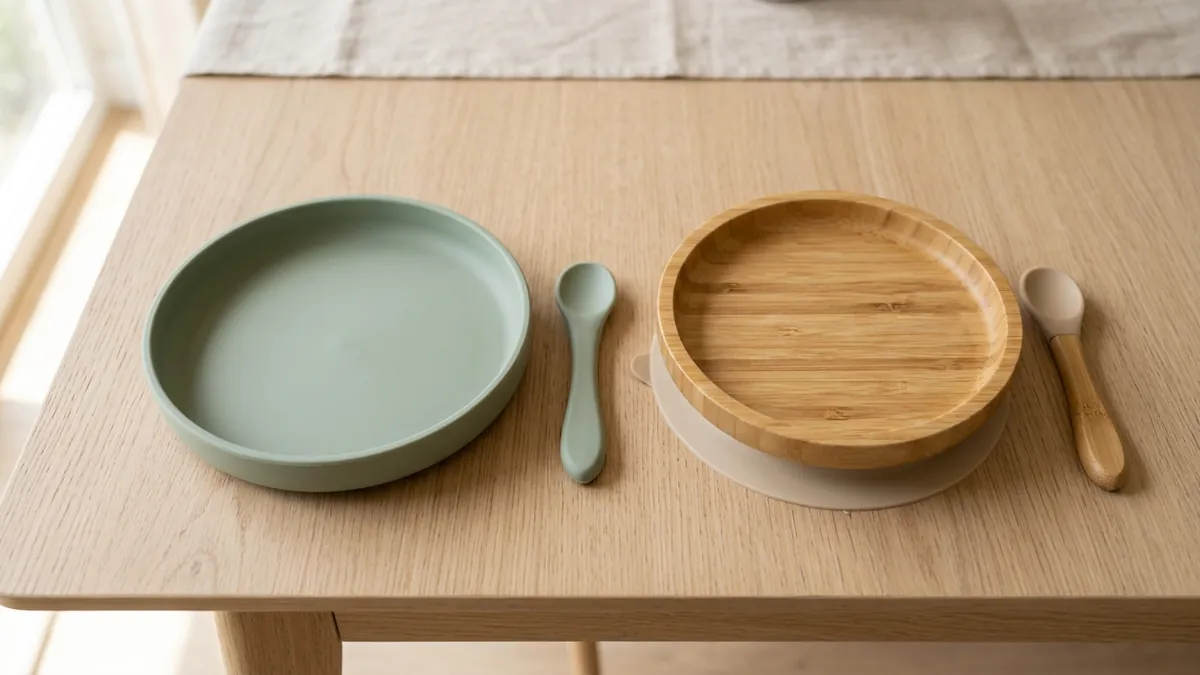
Both materials show up in the same aisle for the same reason: parents looking for something other than hard plastic. Past that, they behave very differently. A silicone baby plate is a soft, flexible piece of food-grade silicone, often with the suction built right into the base. A solid bamboo baby plate is a rigid wooden-looking dish, typically paired with a separate silicone suction ring underneath.
That construction difference drives almost every tradeoff in the silicone vs bamboo plates for baby decision. Silicone is one material from top to bottom, so it can go through the same cleaning cycle all at once. Bamboo is two materials — the plate and the ring — and each one gets its own care rules.
To keep this grounded, we compared the published care instructions of one well-known maker on each side: ezpz’s FAQ for silicone mats and Avanchy’s bamboo suction plate page for bamboo. Other brands may differ, so treat these as examples of each material’s typical care, not rules for every plate on the market.
Cleaning: Dishwasher vs Hand Wash
This is the biggest practical gap between the two, and it compounds over hundreds of meals.
Silicone
ezpz’s FAQ says its mat-based products are dishwasher-, microwave-, and oven-safe up to 350 degrees, and describes them as made from food-safe silicone. For a parent cleaning a plate after every meal, that means the plate goes in with everything else. No separate step, no drying routine.
There’s a small wrinkle worth noticing, though. The same FAQ lists different rules for different ezpz product types — the mats have one set of care instructions, while some of its other items carry their own cautions. Even within one silicone brand, “dishwasher-safe” and “microwave-safe” aren’t blanket promises, so check the page for the exact product you’re buying.
Bamboo
Avanchy’s page recommends hand washing the bamboo, says to avoid soaking it in water for extended periods or putting it in a dishwasher, and suggests periodically treating it with a light coat of oil such as food-grade mineral oil. It also says its bamboo dishware isn’t suitable for any type of oven. The silicone suction ring is removable, and Avanchy says it’s dishwasher-safe on its own.
In practice, that turns cleanup into a two-part job: pop off the ring, wash the plate by hand, dry it, and every so often oil it. None of that is hard. It’s just more steps, and in the silicone vs bamboo plates for baby comparison, steps are what you’re really choosing between.
Suction: How Each One Stays on the Tray
Both styles rely on silicone for suction — silicone plates as part of the plate itself, bamboo plates through a separate ring. So the suction question is less “silicone or bamboo” and more “what surface is it going on?”
ezpz’s FAQ lists wood, laminate, stone, and glass as surfaces its mats seal to, and it adds a caveat: if a tiled or wood surface has holes, divots, or fractures, the seal won’t work as well, and the back of the mat needs to be clean and free of lint and dust. That’s a useful rule of thumb for any suction plate. A smooth, clean tray gives suction its best chance; a scratched or textured one works against it.
For bamboo plates with a removable ring, there’s one extra factor: the ring has to be seated correctly on the plate after every wash. Avanchy frames the removable ring as a feature that lets the plate keep being useful as a child grows. It’s also one more part to reattach properly — which is fine, until you’re doing it one-handed while a hungry baby waits and —
Well. You’ll get fast at it.
If you’re still deciding between a plate and a bowl for the first stage, our suction plate vs suction bowl comparison covers that choice; this one is about the material once you’ve picked the shape.
Durability and the “Bamboo” Label
Durability is where our research has the most gaps. Neither manufacturer publishes a lifespan, and we didn’t run a months-long wear test, so we can’t say which material lasts longer on your specific tray. What the care instructions do show is how each one is meant to be looked after. ezpz describes its silicone as flexible and built to last. Avanchy’s instructions — no soaking, prompt drying, periodic oiling — suggest bamboo needs more upkeep to stay in good shape.
The bigger issue with bamboo is the label itself. Some plates marketed as “bamboo” are solid bamboo; others describe bamboo fiber or a bamboo composite. Those are different products. Before buying, read the materials line in the listing closely. If a listing mentions melamine, the FDA’s Q&A on melamine tableware is clear on one practical point: foods and drinks shouldn’t be heated on melamine-based dinnerware in microwave ovens, and plastic tableware that doesn’t specify it’s microwave-safe shouldn’t be used to heat foods and drinks.
That’s the label detail from the intro, and it’s worth more attention than the silicone vs bamboo plates for baby debate itself. A solid bamboo plate and a bamboo-composite plate can look almost identical in a product photo. Only the listing tells you which one you’re getting.
Which One Fits Your Household?
The silicone vs bamboo plates for baby choice gets easier once you picture your own kitchen on an ordinary Tuesday night. A few situations tip it clearly one way or the other.
If the dishwasher runs every night: silicone fits the routine you already have. Plates go in with the rest of the dishes, and there’s no ring to pop off or wood to dry by hand. For a household where cleanup happens in one batch after bedtime, that single step saved at every meal is the whole argument.
If you’re washing plates for more than one child: multiply every extra step. Two or three bamboo plates a meal means two or three rings to remove, wash, and reattach, plus a drying rack that fills up fast. Silicone plates scale more easily, because the process doesn’t change with the number of plates. This is one place where the silicone vs bamboo plates for baby decision is really a time decision.
If plates travel to daycare or a grandparent’s house: think about who’s washing them there. A bamboo plate that ends up in someone else’s dishwasher or soaking in a sink isn’t being cared for the way the maker recommends. A silicone plate is harder to get wrong in someone else’s kitchen.
If you prefer natural materials and hand-wash anyway: solid bamboo fits well. The extra upkeep is small for a household that already hand-washes wooden spoons and cutting boards, and the removable ring means the plate can be used without suction later on.
If your tray is textured or scratched: the material matters less than the surface. Both plate styles depend on silicone making a seal, and ezpz’s own FAQ notes that holes, divots, or fractures in a surface weaken it. In that case, the silicone vs bamboo plates for baby question may come second to whether any suction plate will grip your tray at all — a plain plate or a bowl held by an adult can be the simpler answer for now.
| Silicone Plates — Pros | Cons |
|---|---|
| Dishwasher-safe on the silicone mats we checked | Care rules can differ by product, even within one brand |
| Suction built into the plate, so there’s no ring to reattach | Soft and flexible, so it doesn’t feel as rigid as a hard plate |
| Microwave- and oven-safe per the maker we checked | — |
| Bamboo Plates — Pros | Cons |
|---|---|
| Rigid, natural-looking plate that feels sturdy | Hand wash only, with no soaking, on the maker we checked |
| Removable suction ring can go in the dishwasher on its own | Not for the microwave or oven, and needs periodic oiling |
| Removable ring lets the plate be used without suction later | — |
Silicone vs Bamboo Plates for Baby: Side-by-Side Comparison
| Feature | Silicone plate | Solid bamboo plate |
|---|---|---|
| Dishwasher | Yes, on the mats we checked | No for the bamboo; yes for the removable ring |
| Microwave | Yes, on the mats we checked | No |
| Extra upkeep | None listed beyond washing | Prompt drying, periodic oiling |
| Suction | Built into the plate | Separate silicone ring |
| Feel | Soft and flexible | Rigid |
| Label to check | Which products the care rules cover | Solid bamboo vs bamboo fiber or composite |
Final Verdict
Silicone vs bamboo plates for baby comes down to how you clean, not which material is “better.” If the dishwasher is where every dish ends up, silicone fits that routine with no extra steps. If you like a rigid, natural-looking plate and don’t mind hand washing and the occasional oiling, solid bamboo with a removable suction ring works well — as long as you’ve confirmed it’s solid bamboo.
Before you buy either, do three things: read the care instructions for the exact product, not just the brand; check the materials line on any “bamboo” plate for words like fiber, composite, or melamine; and look at your tray’s surface, since suction depends on it more than on the plate. For the rest of the feeding setup, our starting solids checklist grades every item from buy-now to can-wait, and our silicone bib vs bandana bib guide covers what catches the food that misses the plate.
Researched: We compared the published care and materials information on ezpz’s FAQ page for silicone mats and Avanchy’s bamboo suction plate page, checked in September 2026, and the FDA’s questions and answers on melamine tableware. We did not test these plates hands-on, and other brands’ care instructions may differ. Nothing here is medical advice.
This post may contain affiliate links. If you purchase through one of these links, we may earn a small commission at no extra cost to you.
Written by The 4 Kids Dad, parent of 4 kids including newborn twins.
Leave a Reply