Table of Contents
This article is for general product-research purposes only and is not medical advice. Talk to your pediatrician about teething, drooling, or feeding concerns specific to your baby.
Short answer: A bandana bib is for drool and teething; a silicone bib is for food once solids start. They’re not really competing for the same job, so the usual “which one should I buy” question is a little off — most parents end up needing both, just at different months, not both at once for the same reason.
Silicone bib vs bandana bib gets framed online as a rivalry — which one wins, which one’s the smarter buy. It isn’t really a rivalry. It’s a timeline. And most of the comparison posts skip that part entirely.
Quick Verdict: Under 6 months and mostly dealing with drool — bandana bib. Past 6 months and dealing with actual food — silicone bib. Somewhere in between, you’ll probably own both and reach for different ones on different days.
Alt text: “Silicone bib vs bandana bib comparison timeline by baby’s age”
Silicone Bib vs Bandana Bib at a Glance
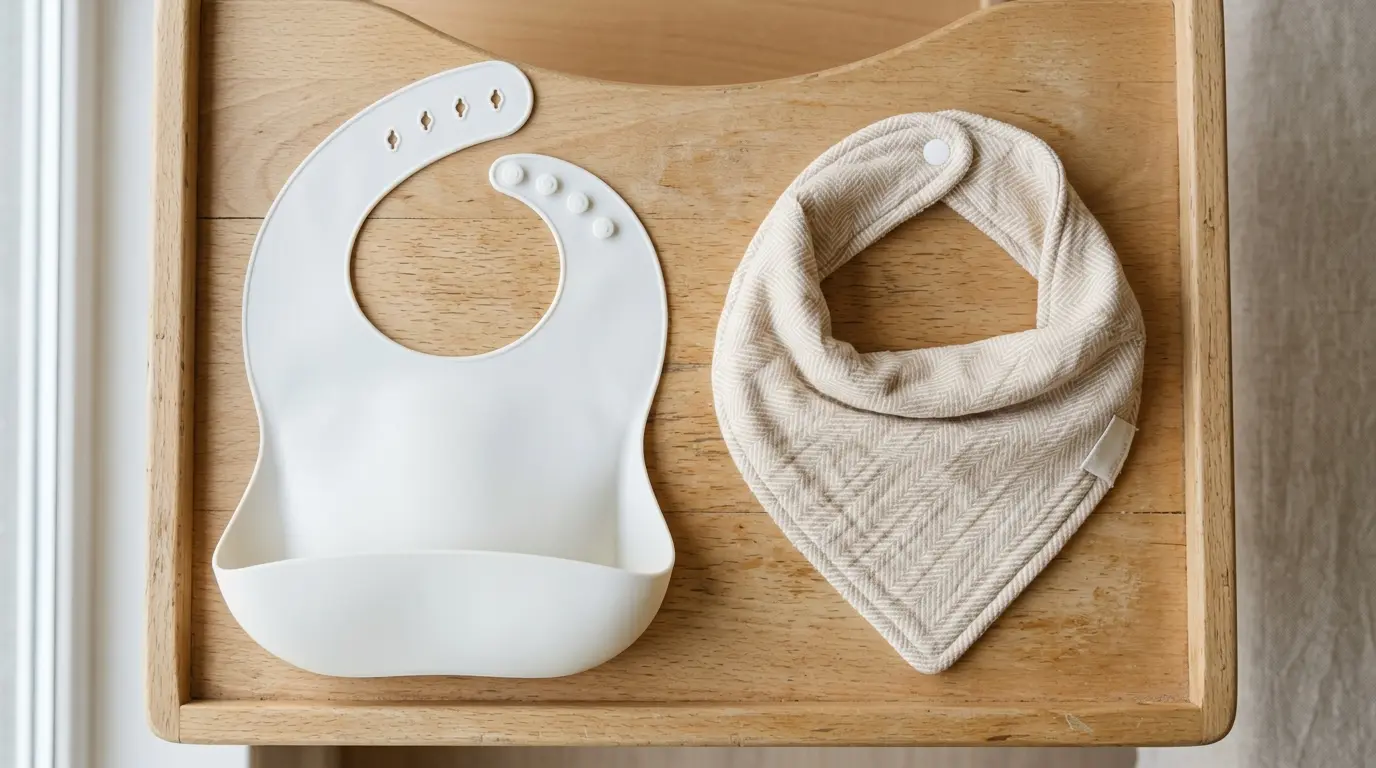
A bandana bib is soft fabric, folded into a triangle, built to absorb — it’s doing the same job as a burp cloth, just wearable. A silicone bib is a stiff, waterproof pocket that sits below a high chair tray and catches food before it lands anywhere else. One soaks things up. The other repels things down. That’s really the whole distinction, and almost everything else follows from it.
0–3 Months: Neither Bib Is Really Doing the Job Yet
At this stage, most of what a baby produces is spit-up after a bottle or nursing session, not the kind of steady drool that a bandana bib is built for. A handful of listings and parenting forums suggest a soft, lightweight cotton bib or a plain burp cloth covers this window better than either product in this comparison — the silicone pocket has nothing to catch yet, and a stiff waterproof bib on a newborn’s neck is, by more than one account, more annoying than useful.
3–6 Months: Bandana Bibs Take Over for Drool and Teething
This is where the bandana bib earns its category. Teething can start well before the first tooth actually appears, and the drool that comes with it isn’t occasional — it’s constant, for weeks at a time in some accounts. A bandana bib’s job is absorption: soft fabric, sometimes with a terry-cloth backing, worn most of the day rather than just at meals.
One inconsistency worth flagging: some listings claim their bandana bibs are “fully waterproof,” while independent reviews of the same products describe them as absorbent-but-not-waterproof — soaking through rather than repelling. That’s a meaningfully different claim, and it’s not always clear which one is accurate for a given SKU without checking recent buyer photos.
6+ Months: Silicone Bibs Take Over Once Solids Start
Once purées and mashed food enter the picture, a bandana bib’s absorbency stops being the useful property — it just gets soaked and stained instead. A silicone bib’s deep, molded pocket is designed to sit below the tray edge and catch what falls, without soaking through to clothing underneath. Multiple listings describe pocket depth as the detail that actually matters here more than brand: a shallow or floppy pocket collapses under the tray and stops catching anything, while a deeper, stiffer pocket holds its shape through a whole meal.
9+ Months: Baby-Led Weaning Pushes Silicone Further, But Bandana Bibs Don’t Disappear
Independent self-feeding — the core of baby-led weaning — is where a silicone bib’s pocket gets used the way it was designed for, catching dropped pieces rather than just spoon drips. It’s hard to say with certainty how much floor mess any single bib prevents without controlled side-by-side testing, so treat “catches most of it” as the honest ceiling rather than a guarantee.
Bandana bibs don’t retire at this point, though — teething can run well past a first birthday for some babies, and plenty of parents keep a bandana bib on for the hours between meals while the silicone bib comes out only at the table.
| Silicone Bib — Pros | Cons |
|---|---|
| Deep catch pocket contains dropped food during self-feeding | Does nothing for drool — it repels rather than absorbs |
| Wipes clean or goes in the dishwasher, generally no laundry needed | Stiffer material some babies resist wearing at first |
| Durable enough to last from early solids through toddlerhood | — |
| Bandana Bib — Pros | Cons |
|---|---|
| Soft, absorbent fabric suited to drool and teething | Saturates fast once real food enters the picture |
| Comfortable for extended all-day wear, not just mealtimes | Needs regular machine washing rather than a quick wipe-down |
| Doubles as a light accessory layer for outfits | — |
Silicone Bib vs Bandana Bib: Feature-by-Feature Breakdown
| Feature | Silicone Bib | Bandana Bib |
|---|---|---|
| Best stage | 6+ months, solids and BLW | 3–6+ months, drool and teething |
| Primary job | Repels and contains food | Absorbs moisture |
| Cleaning | Wipe-clean or dishwasher | Machine wash |
| Typical quantity needed | 2–4 for rotation | 6–10 for rotation |
| Wear pattern | Mealtimes only | All-day, as needed |
Final Verdict
Silicone bib vs bandana bib isn’t a competition with a single winner — it’s a question of what job needs doing this month. Before 6 months, lean bandana for drool and teething. After 6 months, once purées and finger foods start, silicone earns its place at the table. Most households end up running both at once for a stretch, not because neither one is good enough alone, but because drool and food mess don’t stop happening on the same schedule.
Before buying either, check the current listing’s pocket depth (for silicone) or backing material (for bandana) — those two specs affect real-world performance more than brand name does, based on the pattern across the listings checked for this piece. If you’re also still sorting out mealtime gear generally, we compared suction plates vs suction bowls separately.
How We Researched This
Researched: This comparison draws on current product listings, brand descriptions, and parent-facing buying guides for silicone and bandana-style bibs, cross-checked against each other rather than taken from one source. No feeding or medical claims are made; teething and feeding-readiness questions should go to a pediatrician. For general infant feeding guidance, see the CDC’s infant and toddler nutrition resources.
This post may contain affiliate links. If you purchase through one of these links, we may earn a small commission at no extra cost to you.
Written by The 4 Kids Dad, parent of 4 kids including newborn twins.
Leave a Reply