This article compares products for general research purposes only and is not medical advice. When your baby is ready for solids, and when they’re ready to move from one seat to another, are questions for your pediatrician.
Last updated: September 24, 2026
High chair vs booster seat usually gets framed as a price decision. It’s really a floor-space decision that happens to have a price attached. One takes up a corner of your kitchen for as long as you use it; the other borrows a chair you already own and disappears into a cabinet when you’re done. There’s one household where neither answer works on its own, though — and it’s in the twins section further down.
Short answer: A high chair is a freestanding seat with its own legs and tray, so it needs floor space but works anywhere in the room. A booster seat straps onto a dining chair you already own, so it saves space and usually costs less, but it depends on having a sturdy chair that fits it.
Quick Verdict: Plenty of floor space and you want a dedicated feeding station — high chair. Small kitchen, tight budget, or a family that already eats at the table together — booster seat. Twins, or meals split between two homes, often end up with one of each.
Table of Contents
High Chair vs Booster Seat at a Glance
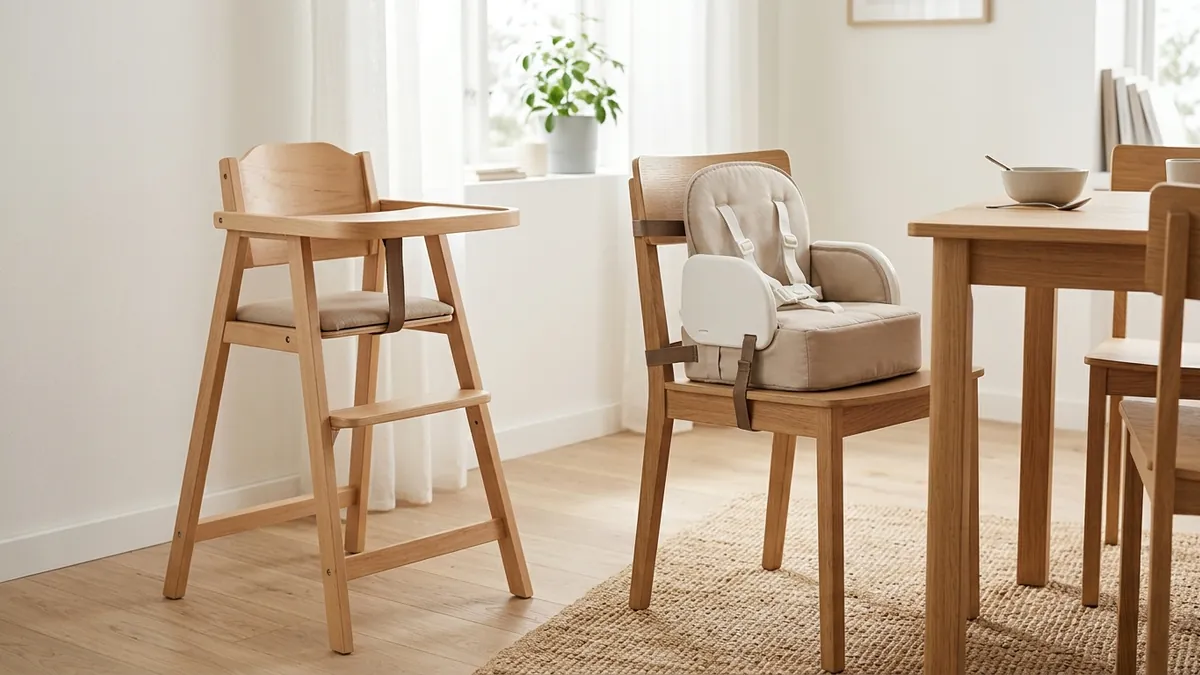
The cleanest way to separate these two is the way the federal rules do it. The CPSC’s high chair guidance describes a high chair as a freestanding chair with a seating surface more than 15 inches above the floor, used to elevate a child for eating. Its booster seat guidance describes a booster seat as a juvenile chair placed on an adult chair to raise a child to standard dining table height.
That’s the whole distinction, really. A high chair brings its own height. A booster seat borrows height from a chair you already have. Almost every other difference in this high chair vs booster seat comparison — space, cost, portability, how long it stays useful — follows from that one fact.
Both are covered by their own federal safety standards, which is worth knowing before you shop secondhand or from an unfamiliar seller. We’ll get to that in the safety section. First, the question that usually decides it: space.
Space: Where Each One Actually Lives
A full-size high chair needs a patch of floor that stays clear, plus room to pull it out, slide the tray on, and get a baby in and out. In a roomy kitchen, that’s a non-issue. In a small apartment with a dining table pushed against the wall, it can mean the high chair lives in a walkway, which is the kind of thing that seems fine until you’ve tripped over its legs at night a few times and —
Right. That’s the week the high chair vs booster seat question tends to come back.
A booster seat takes up no floor space of its own. It sits on a dining chair and is strapped to it, so the footprint is the chair you’d have at the table anyway. When it’s not in use, a booster comes off the chair; how compactly it stores depends on the model, so check the listing’s dimensions.
There’s a middle ground worth knowing about. Some high chairs fold flat, and some have a slimmer frame designed for smaller rooms. They still need floor space when they’re in use, but they can be stored against a wall between meals. If the high chair vs booster seat choice is mostly about space, a folding high chair narrows the gap — just measure the spot where it’ll live before you buy.
One more space factor that’s easy to miss: the table. A booster seat puts your child at the table itself, which works when there’s room for one more person around it. A high chair can sit anywhere, including beside a kitchen counter or in a corner, which matters if your dining table is already full.
Price and Lifespan: What You’re Really Paying For
We’re not going to quote specific prices here, because they shift constantly and vary widely by brand and retailer. The pattern is easier to describe than the numbers. A high chair is a whole piece of furniture — legs, frame, seat, tray, harness — so it tends to cost more upfront. A booster seat is a seat and a set of straps that rely on furniture you already own, so it’s generally the lower-cost option in the high chair vs booster seat decision.
Lifespan complicates that math. Some high chairs are sold as convertible designs that change into a different seat later, which can stretch the value of a higher upfront price. Some boosters stay useful for a long stretch because they simply raise a child at the family table. How long either one stays useful depends on the manufacturer’s stated limits and on your child, so read the listing for the maximum limits rather than going by the product name.
This is also where the honest answer is “it depends on what you’d buy next.” If a convertible high chair replaces a later purchase you’d have made anyway, the higher price may even out. If it doesn’t, you’ve paid for a feature you won’t use. We can’t tell you which applies to your family without knowing what your kitchen looks like two years from now — and neither can a product page.
Secondhand shifts the numbers too. High chairs and boosters both show up used, but a used seat should be checked against the CPSC recall list and inspected for a complete restraint before it goes into rotation.
Safety Standards: What Both Must Meet
Both seats in this high chair vs booster seat comparison have federal standards behind them, and they focus on slightly different risks.
For high chairs, the CPSC’s guidance lists performance requirements that include the restraint system, stability, the integrity of a removable tray or front torso support, and protection against scissoring, shearing, and pinching. When the high chair standard took effect, the CPSC’s 2019 announcement summarized reported incidents into falls while climbing in or out, tip-overs when a child pushed back or rocked, and failures of components like the restraint, tray, or lock. Its advice was to use the safety straps and adjust them to fit snugly, and not to use the tray to hold a child in.
For booster seats, the CPSC’s guidance includes requirements for the child restraint system, tray performance, structural integrity, and the booster seat attachment — how securely it stays fastened to the adult chair underneath it. That attachment piece is the booster’s version of the high chair’s stability question. A booster is only as stable as the chair it’s strapped to, which is why the chair matters as much as the booster.
Practical checks, whichever you choose:
| Check | High chair | Booster seat |
|---|---|---|
| Restraint | Three- or five-point harness per the listing, latches and releases cleanly | Child restraint included and adjustable per the listing |
| Stability | Wide base; doesn’t rock when you push the empty seat | Attachment straps hold firmly to your specific chair |
| Tray | Locks fully into place | If included, locks fully into place |
| Recalls | Search brand and model on CPSC’s recall list | Search brand and model on CPSC’s recall list |
The harness type varies between products — some use a three-point restraint, others a five-point harness — so check what the listing says rather than assuming. And for boosters specifically, check which chair types the manufacturer says it fits. A chair with an unusual shape or a slippery seat may not give the straps much to hold onto.
Which One Fits Your Household?
The logic of this high chair vs booster seat comparison is simple: match the seat to the house, not to a ranking. Here’s how it plays out for a few common setups.
Small Apartments
In a small apartment, the high chair vs booster seat choice usually tips toward the booster, because it adds no footprint. The exception is a home where the dining chairs themselves don’t work with a booster — stools, benches, or chairs without a solid seat. In that case a slim or folding high chair may be the only realistic option, and the question becomes where it can stand without blocking a path. We compared five of those in our best high chair for small spaces roundup.
Twins
This is the household where high chair vs booster seat stops being an either-or question. Two babies eating at the same time means two seats in use at the same time, and two full-size high chairs can swallow a small kitchen. One workaround is one of each — or two boosters on two dining chairs if the table has room. The tradeoff: boosters put both babies at the table within reach of everything on it, while high chairs can be spaced apart. If you’re setting up for twins, map out both seats side by side before buying either.
Two Homes or Frequent Travel
If meals regularly happen at a grandparent’s house or while traveling, a booster seat’s portability matters more than its price. Some families keep a high chair at home and a booster for everywhere else. That’s more gear, yes. But it’s often less hassle than carrying a high chair between houses — which, depending on the model, isn’t really an option at all.
What we can’t predict is how your child will take to either seat. Some babies settle into a high chair tray without fuss; others are happier at the family table from the start. It’s reasonable to expect some trial and error.
| High Chair — Pros | Cons |
|---|---|
| Freestanding, so it works anywhere in the room | Needs its own floor space, which small kitchens may not have |
| Own tray and harness make it a self-contained feeding station | Higher upfront cost than a booster in general |
| Some convertible designs change into a later seat | — |
| Booster Seat — Pros | Cons |
|---|---|
| No extra footprint; it uses a chair you already own | Only as stable as the chair it’s strapped to |
| Generally lower cost upfront | Not every chair type works with every booster |
| Easier to carry to another home or on a trip | — |
High Chair vs Booster Seat: Side-by-Side Comparison
| Feature | High Chair | Booster Seat |
|---|---|---|
| How it’s defined | Freestanding, seat more than 15 inches above the floor | Placed on an adult chair to reach table height |
| Floor space | Needs its own spot | None beyond the dining chair |
| Upfront cost | Generally higher | Generally lower |
| Portability | Low; some fold for storage | High; comes off the chair |
| Stability depends on | Its own base and legs | The adult chair and attachment straps |
| Federal standard | CPSC high chair standard | CPSC booster seat standard |
| Best fit | Roomy kitchens, a dedicated feeding spot | Small spaces, family-table meals, travel |
Final Verdict
High chair vs booster seat doesn’t have a universal winner, and it isn’t really about which one is safer or better built — both have federal standards to meet. It comes down to where your child will eat. A dedicated spot with room to spare points to a high chair. A small kitchen, a family table with an open seat, or meals split between two homes points to a booster.
The seat is only one line of the feeding setup. Our starting solids checklist grades every item — seat, bibs, spoons, cups, storage — from buy-now to can-wait, so you can see where this decision fits in the bigger list.
Before you buy, do three things: measure the spot where the seat will live, check which of your dining chairs a booster would attach to, and look up the exact model on the CPSC recall list. If you’re also sorting out what goes on the tray, we compared suction plates vs suction bowls, and our silicone bib vs bandana bib breakdown covers the mess that comes with either seat.
Researched: This comparison is built from the CPSC’s business guidance pages for high chairs and booster seats, the CPSC’s announcement of the federal high chair standard, and the CPSC recall database. We did not test specific products hands-on, and we don’t quote prices because they change too often to stay accurate. Nothing here is medical advice; questions about when your child is ready to switch seats belong with your pediatrician.
This post may contain affiliate links. If you purchase through one of these links, we may earn a small commission at no extra cost to you.
Written by The 4 Kids Dad, parent of 4 kids including newborn twins.
Leave a Reply