Table of Contents
This article is for general product-research purposes only and is not medical or nutritional advice. Talk to your pediatrician before introducing solid foods or changing your baby’s feeding routine.
Short answer: A suction bowl generally holds more food and suits early purees, while a suction plate suits the baby-led-weaning stage once a baby is picking up finger foods and needs separated sections. Most parents starting solids end up owning both within the first few months, just not on the same day.
Suction plate vs suction bowl is one of those decisions that looks small on a registry checklist and stops being small the first time a bowl goes airborne mid-meal. It isn’t really a brand question. It’s a stage question, and the stage matters more than any single listing photo suggests.
Quick Verdict: In the purée stage — go with a suction bowl, steep sides, one compartment. Past that, once finger foods and self-feeding take over — a divided suction plate starts earning its shelf space.
Alt text for image upload: “Suction plate vs suction bowl feature comparison chart”
Suction Plate vs Suction Bowl at a Glance
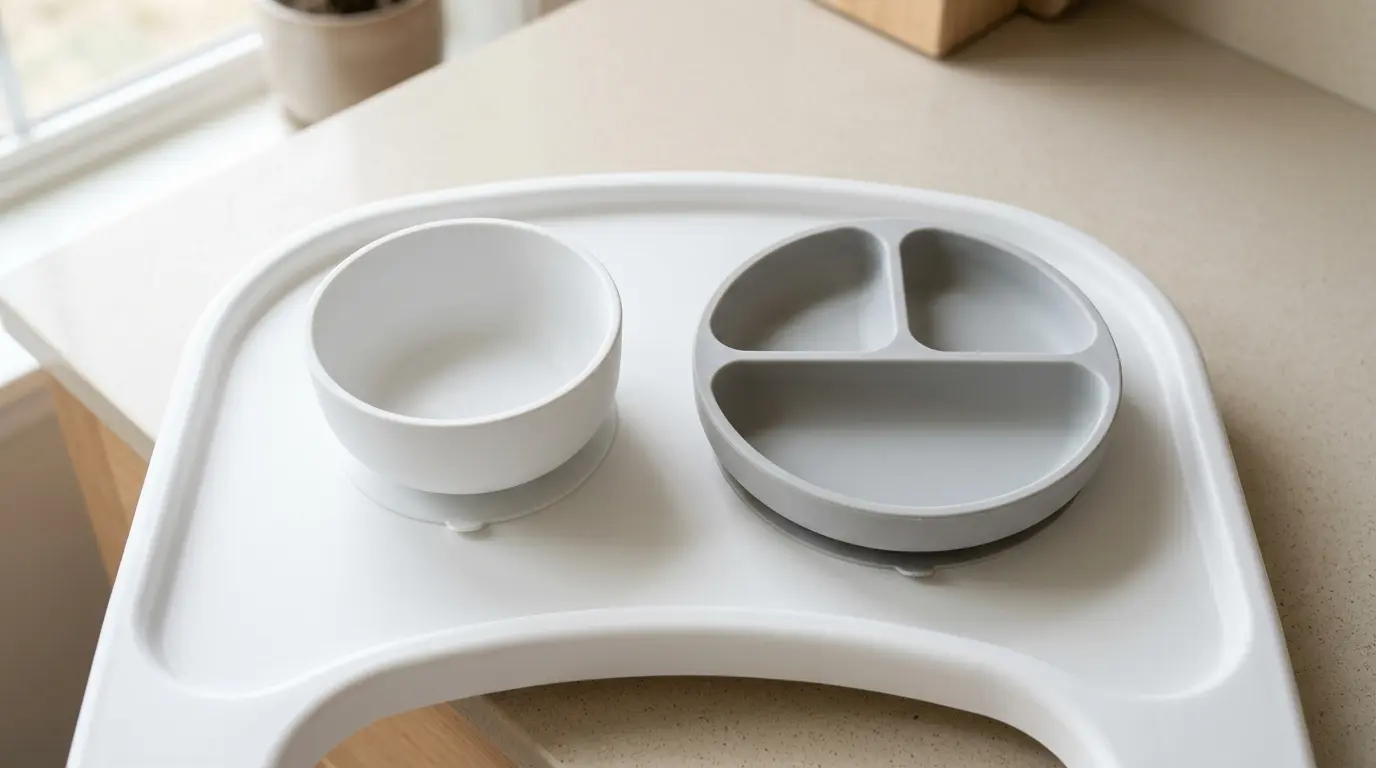
The suction plate vs suction bowl split comes down to depth and division. A bowl is one deep well, built to hold purees, yogurt, or oatmeal without a spoonful ending up on the floor. A plate is flatter and usually split into two or three sections, built for the stage where a baby is grabbing pieces of banana or toast with their own hand.
Neither one replaces the other for long. Most feeding-gear listings and parent discussion threads point to the same pattern: bowls come first, plates follow a few weeks or months later, and by the toddler stage both tend to sit in the same cabinet drawer.
What a Suction Bowl Does Well
A bowl’s whole job is containment. High sides keep a loaded spoon from sliding food out mid-scoop, which matters more than it sounds like it should during the purée stage, when a baby’s aim is — generously — still a work in progress.
| Pros | Cons |
|---|---|
| Deep single well holds purees and thicker foods without spillover | Not divided, so mixing sweet and savory foods happens by default |
| Works for spoon-feeding and early self-feeding with a pre-spoon | Less useful once a baby wants to pick up separate finger foods |
| Simple single-piece shape, generally easy to hand-wash | — |
Where a Suction Plate Pulls Ahead
Once a baby starts reaching for food instead of waiting for the spoon, a plate’s divided layout stops being a nice-to-have. Keeping textures apart isn’t just tidiness — some babies flatly refuse a meal the second two foods touch, and a divided surface sidesteps that fight before it starts.
| Pros | Cons |
|---|---|
| Divided sections keep foods separate for picky or texture-sensitive eaters | Shallower profile means loose or wet foods can slide past the edge |
| Matches the baby-led-weaning stage where independent grabbing is the point | Suction failure is more noticeable here, since a tipped plate spills across every section at once |
| Tends to double as a toddler snack plate long after weaning ends | — |
Suction Strength: What the Listings and Reviews Suggest
Here’s where things get less tidy than either product page wants to admit. Across the current listings and parent-review threads checked for this piece, suction performance shows up as the single most inconsistent variable — not between the bowl and plate categories, but between individual trays and tables. A textured high-chair tray, a wood-grain finish, or a surface that isn’t fully dry seems to defeat the suction base regardless of whether it’s under a bowl or a plate.
One listing’s product photo showed a raised suction lip that the written description didn’t actually mention, while a nearly identical competitor described “medical-grade suction” without showing the base at all — a small inconsistency worth flagging rather than smoothing over. It’s hard to say, without months of side-by-side wear on the same tray, which specific base design holds up best long-term; that part is closer to directional than settled.
One exception worth naming: nothing in either category claims to work reliably on a textured or non-flat surface. That limitation shows up across brands, not just one.
Cleanup, Materials, and Growing With Your Baby
Silicone dominates both categories now, mostly because it’s dishwasher-safe, doesn’t crack the way early hard-plastic suction bases did, and softens the edge a baby gums on. Bamboo-backed options show up too, marketed on sustainability, though several listings note they need hand-washing rather than a dishwasher cycle — worth checking before assuming otherwise.
A bowl generally ages out first, as soon as a baby moves past purées. A plate tends to stick around into the toddler years as a portioned snack tray, which is part of why it’s often described as the better long-term buy — not because it’s better at any single job, but because it stays useful longer.
Suction Plate vs Suction Bowl: Feature-by-Feature Breakdown
| Feature | Suction Bowl | Suction Plate |
|---|---|---|
| Best stage | Purée stage, early solids | Finger-food stage, self-feeding |
| Food capacity | Higher, single deep well | Lower, split across sections |
| Divided sections | Typically none | Usually 2–3 |
| Common materials | Silicone, some bamboo-backed | Silicone, some bamboo-backed |
| Cleanup | One surface to wipe | Corners between dividers need attention |
| Longevity of use | Shorter window before baby outgrows it | Often reused into toddlerhood as a snack tray |
Final Verdict
If a baby is just starting solids and still mostly on purées, a suction bowl is the lower-risk first purchase. If a baby is already past that stage and reaching for food independently, a divided suction plate does more of the actual job. Buying both, staggered a few weeks apart instead of together, matches how most parents seem to end up using them anyway. For the rest of the feeding gear, our starting solids checklist grades every item from buy-now to can-wait. And since neither dish keeps food out of a lap, our silicone bib vs bandana bib comparison covers the other half of mealtime mess. If you’re also deciding between materials, our silicone vs bamboo plates for baby comparison looks at dishwasher rules and upkeep. Not sure a suction plate will grip your tray? Our suction plate for high chair guide covers which tray surfaces work.
Before buying either one, check the current listing for the specific tray or highchair you already own — suction performance depends more on that surface than on which category you pick, and a quick look at recent buyer photos on the product page will usually show whether a given base holds up on a similar surface.
How We Researched This
Researched: This comparison was built from a review of current baby-feeding-gear product listings, brand descriptions, and parent discussion threads discussing baby-led weaning and suction gear, cross-checked against each other for consistency rather than taken from a single source. No clinical or nutritional claims are made; feeding readiness and safety questions should go to a pediatrician. For general infant feeding guidance, see the CDC’s infant and toddler nutrition resources.
This post may contain affiliate links. If you purchase through one of these links, we may earn a small commission at no extra cost to you.
Written by The 4 Kids Dad, parent of 4 kids including newborn twins.
Leave a Reply