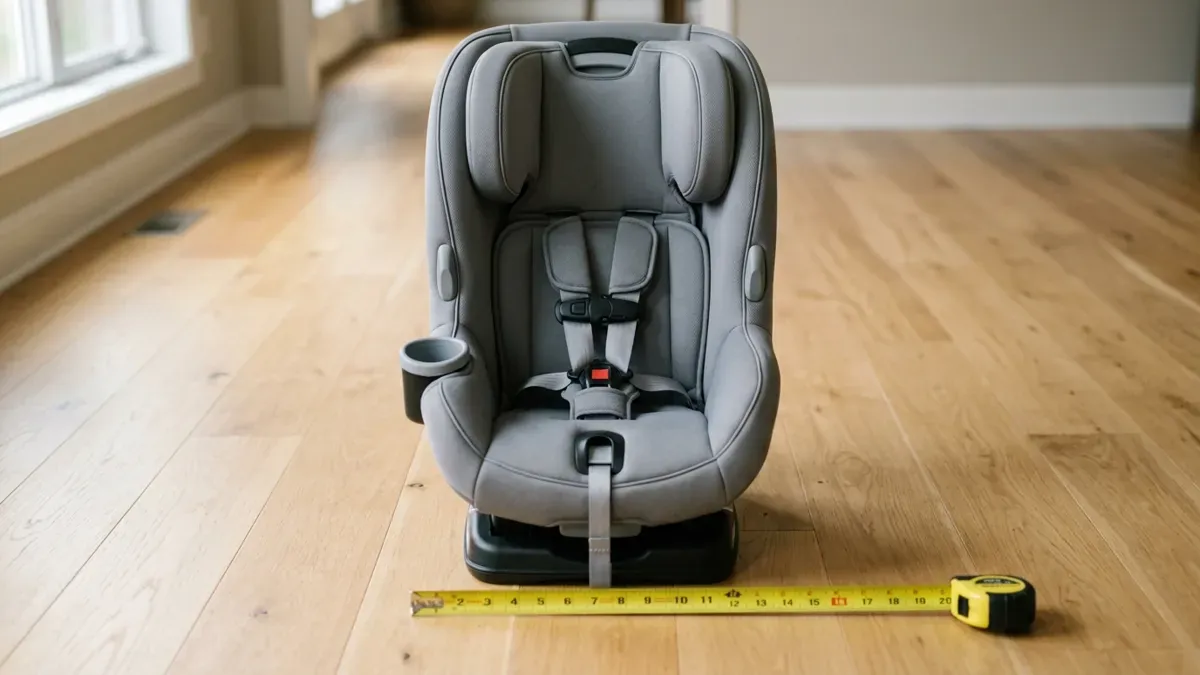
A car seat width chart answers one question fast: how many inches does each seat list, and how many inches does your back seat list? This page puts both on one page, using only numbers from manufacturers’ own pages, and then shows how to turn them into a three-across estimate you can check with a tape measure. It’s a reference we update, not a verdict on any seat.
Car Seat Width Chart: Every Seat We Verified
Last verified: October 6, 2026. Every row below comes from the manufacturer’s product page linked in the last column (official spec). We haven’t used or measured any of these seats, so none is personally tested. Each manufacturer measures width its own way, so the labels under the tables matter as much as the numbers.
Harnessed seats: all-in-one, rotating, and convertible
| Seat | Type | Listed width (in) | Source |
|---|---|---|---|
| Graco SlimFit3 LX 3-in-1 | All-in-one | 16.7 | Graco product page |
| Chicco Fit3x ClearTex | All-in-one | 16.7 | Chicco product page |
| Evenflo All4Stages Slim 4-in-1 | All-in-one | 16.9 | Evenflo product page |
| Evenflo Revolve360 Slim 2-in-1 | Rotating | 16.9 | Evenflo product page |
| Clek Fllo | Convertible | 16.9 | Clek product page |
| Clek Foonf | Convertible | 16.9 | Clek product page |
| Britax Poplar | Convertible | 17 (from product dimensions) | Britax product page |
The Clek seats list a seating width of 16.9 inches and a separate 13-inch base width, and the table uses the seating width because that’s the wider number a row has to hold. Britax lists 17 inches as the middle figure of its product dimensions of 20.5 by 17 by 23.5 inches.
Boosters: highback and backless
| Booster | Type | Listed width (in) | Source |
|---|---|---|---|
| Graco TurboBooster 2.0 Highback | Highback | 16.73 | Graco product page |
| Chicco KidFit 2-in-1 | Highback and backless | 17 | Chicco product page |
| Clek Ozzi | Backless | 18 (with armrests) | Clek product page |
| Clek Olli | Backless | 18 (with armrests) | Clek product page |
| Clek Oobr | Highback | 18 rear, 15.5 front | Clek product page |
Booster widths are less alike than harnessed seats. Graco and Chicco list a single product or total width, while Clek lists the Ozzi and Olli at 18 inches including armrests (12.75 inches for the cushion alone) and the Oobr at 18 inches at the rear, 15.5 inches at the front, and 20 inches with its detachable cup holder. Our narrowest booster seat guide explains how those differences change a row.
Table of Contents
1. How to Read a Listed Car Seat Width
A listed width is a number a manufacturer chose to publish, and it isn’t always the widest part of the seat as it sits in a car. Graco’s page labels its figure “product width,” Chicco labels its figure “product total width,” Clek separates a seating width from a base width, and Evenflo and Britax describe a slim profile or product dimensions. Treat the numbers as comparable on paper, not as measurements made the same way.
We left a seat out of the chart whenever we couldn’t find a width on its official page. That’s why some seats we researched aren’t here, such as UPPAbaby’s Aria V2 and Mesa V3 infant seats, where we found weight and height ranges but no width. A blank cell can look like a “no,” so the chart simply doesn’t list a seat until a number exists.
Notes also change what a width means. Cup holders and armrests may add inches at some seats; Clek, for example, lists the Oobr at 18 inches at the rear but 20 inches with its cup holder. Our narrowest car seats for 3 across ranking ranks the harnessed seats above on listed width, and our two rotating car seats in captain’s chairs guide covers how rotating seats behave in tight rows.
2. Second-Row Hip Room for Sedans and SUVs
Last verified: September 29 to October 2, 2026, shown in each row. Each figure is the second-row hip room the automaker lists for that model and year (official spec). Automakers publish one figure per model, we didn’t confirm trim-by-trim differences, and each linked page may change when a model year changes.
Sedans
| Vehicle | Model year | Second-row hip room (in) | Source and date checked |
|---|---|---|---|
| Honda Civic | 2026 | 48.9 | Honda specs, Sep 29 |
| Hyundai Elantra | 2026 | 50.5 | Hyundai specs, Sep 29 |
| Toyota Corolla | 2027 | 51.3 | Toyota specs, Sep 29 |
| Toyota Crown | 2027 | 53.1 | Toyota specs, Sep 29 |
| Hyundai Sonata | 2026 | 54.4 | Hyundai specs, Sep 29 |
| Toyota Camry | 2026 | 54.6 | Toyota specs, Sep 29 |
| Honda Accord | 2026 | 55.4 | Honda specs, Sep 29 |
| Kia K5 | 2027 | 56.6 | Kia specs, Sep 29 |
SUVs and minivans
| Vehicle | Model year | Second-row hip room (in) | Source and date checked |
|---|---|---|---|
| Toyota RAV4 (Limited and Woodland specs) | 2026 | 49.6 | Toyota specs, Sep 30 |
| Honda CR-V | 2027 | 52.6 | Honda specs, Oct 2 |
| Hyundai Santa Fe | 2027 | 54.9 | Hyundai specs, Oct 2 |
| Kia Sorento | 2026 | 55.1 | Kia specs, Oct 2 |
| Kia Telluride | 2027 | 56.5 | Kia specs, Oct 2 |
| Hyundai Palisade | 2027 | 56.7 | Hyundai specs, Oct 2 |
| Toyota Grand Highlander (8-passenger bench trim) | 2025-2026 | 57 | Toyota specs, Oct 2 |
| Honda Pilot (bench or captain’s chairs by trim) | 2026 | 57.4 | Honda specs, Oct 1 |
| Toyota Sienna (LE with bench) | 2026 | 66.2 | Toyota specs, Oct 2 |
Hip room is the figure automakers list, and it isn’t the width of the seat cushion, so measure the cushion yourself. The Sienna row lists the LE trim with a bench that has a stowable center seat, so it isn’t comparable to the bench rows above. Our sedan fit guide, SUV ranking, RAV4 guide, Honda Pilot guide, Grand Highlander guide, and Sienna configuration guide go deeper on individual vehicles.
3. Putting the Two Charts Together for Three Across
The arithmetic is simple. Add the listed widths of the three seats, then subtract the total from the vehicle’s second-row hip room. Three 16.7-inch seats come to 50.1 inches on paper, three 16.9-inch seats to 50.7 inches, and three 17-inch seats to 51 inches. The table shows what that leaves, in inches, for each vehicle above except the Sienna.
| Vehicle and second-row hip room | Three 16.7 in seats | Three 16.9 in seats | Three 17 in seats |
|---|---|---|---|
| Honda Civic 2026, 48.9 in | -1.2 in | -1.8 in | -2.1 in |
| Toyota RAV4 2026, 49.6 in | -0.5 in | -1.1 in | -1.4 in |
| Hyundai Elantra 2026, 50.5 in | 0.4 in | -0.2 in | -0.5 in |
| Toyota Corolla 2027, 51.3 in | 1.2 in | 0.6 in | 0.3 in |
| Honda CR-V 2027, 52.6 in | 2.5 in | 1.9 in | 1.6 in |
| Toyota Crown 2027, 53.1 in | 3.0 in | 2.4 in | 2.1 in |
| Hyundai Sonata 2026, 54.4 in | 4.3 in | 3.7 in | 3.4 in |
| Toyota Camry 2026, 54.6 in | 4.5 in | 3.9 in | 3.6 in |
| Hyundai Santa Fe 2027, 54.9 in | 4.8 in | 4.2 in | 3.9 in |
| Kia Sorento 2026, 55.1 in | 5.0 in | 4.4 in | 4.1 in |
| Honda Accord 2026, 55.4 in | 5.3 in | 4.7 in | 4.4 in |
| Kia Telluride 2027, 56.5 in | 6.4 in | 5.8 in | 5.5 in |
| Kia K5 2027, 56.6 in | 6.5 in | 5.9 in | 5.6 in |
| Hyundai Palisade 2027, 56.7 in | 6.6 in | 6.0 in | 5.7 in |
| Toyota Grand Highlander 2025-2026, 57 in | 6.9 in | 6.3 in | 6.0 in |
| Honda Pilot 2026, 57.4 in | 7.3 in | 6.7 in | 6.4 in |
A negative number means the seats don’t fit on paper, and a small positive number means a very tight row, since the margin has to cover buckle access and the bulge of each seat. These figures are our arithmetic from two official numbers, labeled on paper, and they’re not a prediction that the seats will or won’t fit.
The pattern is useful anyway. In the compact sedans at the top, three slim harnessed seats may not fit on paper, while the larger sedans and most three-row SUVs may leave more margin on paper. Mixed rows use the same method: add each seat’s listed width and subtract. Our 3 car seats across guide walks through whole rows step by step.
4. Three Worked Examples With the Chart
These examples use only numbers from the tables above, and they stay on paper. Nothing here says a row works, only whether the arithmetic leaves any margin.
A compact sedan with two slim seats and a booster. The 2026 Hyundai Elantra lists 50.5 inches of second-row hip room. Two Graco SlimFit3 LX seats at 16.7 inches each and a Graco TurboBooster 2.0 at 16.73 inches add up to 50.13 inches, which leaves 0.4 inches. That’s a very small margin, and a booster still needs belt access, so this row would need a tape measure and a test install before anyone relies on it.
A midsize sedan with a mixed row. The 2026 Toyota Camry lists 54.6 inches. A Britax Poplar at 17 inches, a Chicco KidFit at 17 inches, and a Clek Ozzi at 18 inches (with armrests) total 52 inches, which leaves 2.6 inches. On paper, that margin is larger than in the compact sedans.
A compact sedan that fails the math. The 2026 Honda Civic lists 48.9 inches. Two Graco SlimFit3 LX seats take 33.4 inches and leave 15.5 inches, and no booster in the chart lists a width under 16.7 inches, so a third seat doesn’t fit on paper. On paper, a third seat doesn’t fit here, so measure before deciding.
5. Width Tiers: A, B, and C
To scan the chart quickly, we group the listed widths into three tiers. The tiers are our grouping for reading, not a safety or quality rating, and a seat in tier A isn’t better than a seat in tier C.
| Tier | Listed width | Seats in this chart |
|---|---|---|
| A | 16.7 to 16.9 in | Graco SlimFit3 LX, Chicco Fit3x, Evenflo All4Stages Slim, Evenflo Revolve360 Slim, Clek Fllo, Clek Foonf, Graco TurboBooster 2.0 |
| B | 17 in | Britax Poplar, Chicco KidFit |
| C | 18 in or wider as listed | Clek Ozzi, Clek Olli, Clek Oobr (rear width) |
The gap between tiers is small in inches but large in a row. Moving a seat from tier A to tier C adds a little over an inch, and across three seats that can decide whether a row works on paper. Use the tiers to start a shortlist and the arithmetic in section 3 to check it.
6. Why the Numbers Aren’t Enough
Two official numbers can’t tell you how seats sit together. A checklist from our sedan guide applies here: measure the flat cushion width between the door panels instead of relying on a spec sheet, check the raised floor hump in the center, and confirm that no seat base sits directly over a buckle receiver. NHTSA’s installation tips say a seat should not move more than 1 inch side to side or front to back when pulled at the belt path, so test every seat that way without letting it lean on its neighbors.
Buckle access is where rows most often fail even when the arithmetic works. Our guide to buckling car seats too close together explains the fixes, and our common car seat installation mistakes guide covers the errors that come up most often. If any step feels uncertain, a certified technician can help, and many fire and police stations offer free inspections, according to NHTSA.
7. Where Boosters Fit in the Row
A booster changes the row in two ways: its width, and the vehicle seat belt that does the work. The widths above come from the manufacturers’ pages, but a booster has no harness, so buckle access matters even more. Our narrowest booster seat guide subtracts two slim seats from several vehicles’ hip room to see what is left for a booster, and the same math works with any pair of seats from the chart.
Check your vehicle’s owner’s manual for whether a booster is allowed in the center position and with which belt, since the chart can’t answer that. Add the booster’s width to the other two seats as in section 3.
8. Keep Each Seat Within Its Useful Life
A seat that fits your row still has a life limit. Manufacturers state it from the date of manufacture, and the limit varies by brand and by model. Our car seat expiration date guide lists the periods we found and shows how to read the date, and our infant vs convertible car seat guide explains how those seat types differ.
9. What Isn’t in the Chart Yet
A reference chart is only as honest as its gaps. These are the ones we know about, so you don’t read a missing row as a “no.”
- Seats without a listed width. UPPAbaby’s Aria V2 and Mesa V3 infant seats, and some other seats we researched, are missing because we couldn’t find a width on an official page. We’ll add them when a number exists.
- Vehicles without a second-row hip-room figure. The Kia Carnival is missing because we haven’t confirmed an official hip-room figure for its captain’s chairs. Some other automakers’ pages didn’t load for us, so those models aren’t listed either.
- Trim differences. Automakers publish one hip-room figure per model, and we didn’t compare trims. The RAV4 figure comes from the Limited and Woodland specifications, the Grand Highlander figure from an 8-passenger bench trim, and the Sienna figure from the LE with a bench.
- Measured widths. Every width is a manufacturer’s listing. We haven’t measured any seat, so a seat that’s wider at one point than its listed figure isn’t reflected here.
If you spot a number that’s out of date, check it against the linked page first, since manufacturers change listings when they update a model.
10. Related Guides in This Cluster
- 3 car seats across: the full guide to fitting three seats in one row.
- Narrowest car seats for 3 across: seven slim harnessed seats ranked by listed width.
- Narrowest booster seat: booster widths and the row math.
- Sedans that fit 3 car seats and SUVs that fit 3 car seats across: vehicle lists.
- RAV4, Pilot, Grand Highlander, and Sienna: single-vehicle guides.
- Buckling car seats too close together and common installation mistakes.
How We Built and Update This Chart
Researched: every width comes from the manufacturer’s product page linked in Table 1, and every hip-room figure from the automaker’s own specifications page linked in Table 2, checked on the dates shown. We haven’t used or measured any of these seats or vehicles, so none is personally tested. Rows without an official source are left out. The three-across arithmetic is ours and is labeled on paper. We update the chart when a manufacturer changes a listing or a model year changes, and we show the date checked beside the numbers.
This is general product research, not a substitute for your seats’ manuals, your vehicle owner’s manual, or a car seat inspection. Follow each manual, and a certified technician can help check the finished row.
This post may contain affiliate links. If you purchase through one of these links, we may earn a small commission at no extra cost to you.
By The 4 Kids Dad · Updated October 6, 2026. Parent of 4 kids, including newborn twins.
Leave a Reply