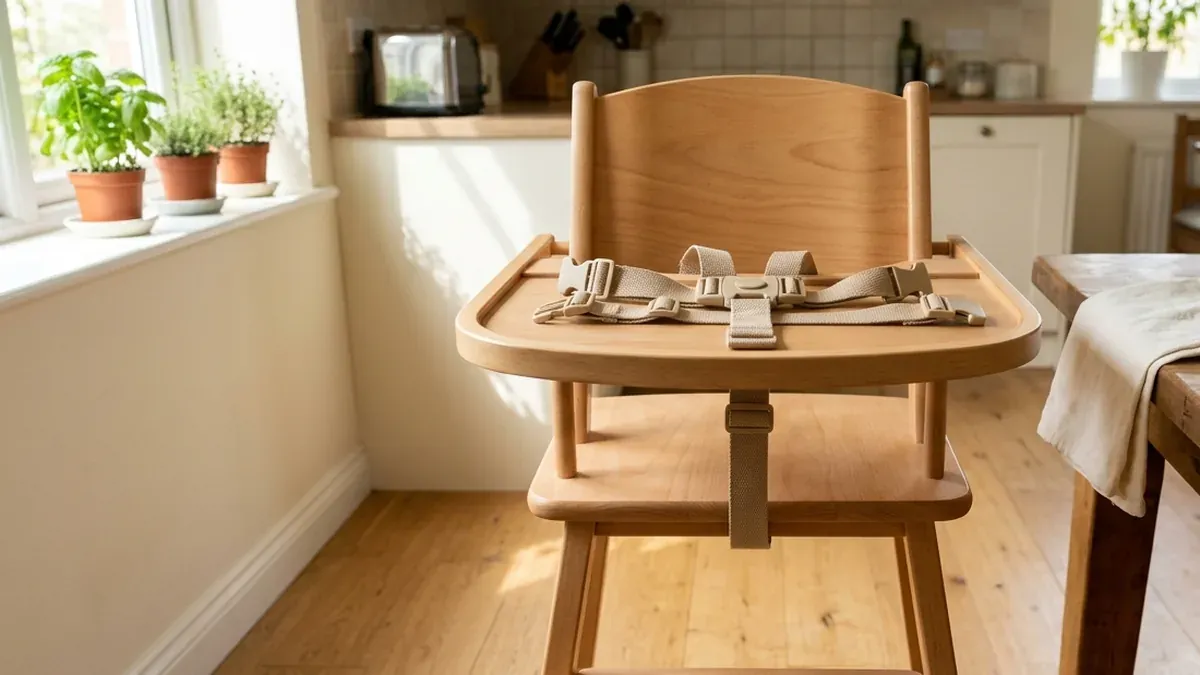
We read the cleaning text on the product pages of two high chairs, and neither gives steps for the harness straps. That is the surprise behind this guide on how to clean high chair straps: the straps collect spills like any other part, yet the manufacturers’ own text we read says nothing about them. So this guide covers what the makers do say about the seat, the frame, and the tray, and where you’ll need your own manual.
Table of Contents
The two chairs are the Graco Slim Snacker and the Joovy Nook, and the sources are their own product pages, read on October 7, 2026. We haven’t used either chair, so nothing here is personally tested. The IKEA Antilop and the Stokke chairs in our small-spaces high chair guide aren’t covered, because we limited this guide to two chairs whose care text we could read in full. Neither maker’s page gives step-by-step harness strap instructions, so we don’t invent them.
Researched: care wording comes from Graco’s Slim Snacker page and Joovy’s Nook page (official spec).
Mistake 1: Cleaning Before You Read the Manual
Why it happens: a damp cloth feels like a safe default. But Graco’s page says to wipe the seat pad with a damp cloth or machine wash it separately in cold water, to clean the frame with only household soap and warm water, and for the tray to “refer to your user manual.” Three parts of one chair, three different instructions.
The fix: find the manual for your exact model before you clean. If you’ve lost it, for the tray Graco’s page refers you to the user manual or Customer Service, and Joovy’s page links an instruction manual and lists a US-based Consumer Care team at 1-877-456-5049. Ask your maker for the cleaning steps for the harness straps in particular.
Mistake 2: Reaching for Bleach on the Frame
Why it happens: bleach feels like the strongest answer to a sticky chair. Graco’s page is direct about the frame: use only household soap and warm water, and no bleach.
The fix: keep to soap and warm water for the frame, as Graco says. That instruction is for the frame, not the straps, and we didn’t find a maker statement about straps, so the same caution is a reason to check the manual and not a rule we can quote.
Mistake 3: Machine Washing the Seat Pad the Wrong Way
Why it happens: a washable pad invites a quick toss in with the laundry. Graco’s wording is specific: machine wash the seat pad separately in cold water, and wiping with a damp cloth is listed first.
The fix: wipe first, and if you wash, wash the pad on its own in cold water. Leave the harness straps out of the wash unless your manual says they can go in. That is our caution, not a maker’s rule: Graco’s care text covers the seat pad and doesn’t mention the straps.
Mistake 4: Assuming “Dishwasher Safe” Covers the Whole Chair
Why it happens: one dishwasher-safe label gets stretched to everything. Joovy’s page lists a removable dishwasher-safe tray insert, and says the leatherette seat cover wipes clean. The dishwasher claim is for the insert only.
The fix: put in the dishwasher only the part a maker names as dishwasher safe, and wipe the seat cover the way the maker describes. For anything attached to it, such as the straps, check your manual first. If you’re choosing a plate for the tray, our suction plate for high chair guide explains how to check that the plate will stay on.
Mistake 5: Treating the Straps Like the Seat Pad
Why it happens: the straps sit against the seat pad, so it seems fair to clean them the same way. But the makers’ own text for either chair covers the pad, the frame, and the tray, and doesn’t say whether a strap can be soaked, machine washed, or scrubbed. Joovy lists a five-point harness and Graco a convertible 3- and 5-point harness, and both are safety parts.
The fix: don’t improvise. Look for a strap-cleaning line in your manual. If there isn’t one, ask the maker before you try any cleaning method on them, and note the answer inside the manual so you don’t have to ask again.
Mistake 6: Waiting Until Everything Is Crusted On
Why it happens: mealtime ends, the child is out, and the chair gets a glance. This one is our reasoning, not a manufacturer’s rule: dried food is harder to remove than fresh food, so a regular wipe-down with the method your manual lists is easier than a deep clean later.
The fix: decide on a routine you’ll actually keep, such as wiping the tray and seat after each meal with the method your manual gives, and a fuller clean when the chair gets visibly dirty. Both chairs we read are described by their makers as easy to wipe: Graco calls the seat pad wipeable and Joovy says the leatherette seat wipes clean. A chair with a wipeable seat is simpler to keep up.
How to Clean High Chair Straps in the Same Pass as the Tray and Cushion
You’ll rarely clean the straps alone, so it helps to fold them into one pass. Here is an order we suggest, using what each maker says about its own chair:
- Tray: Joovy lists a removable, dishwasher-safe insert. Graco says to refer to the manual for the tray, so don’t guess.
- Seat pad or cover: Graco says wipe with a damp cloth or machine wash the pad separately in cold water. Joovy says its leatherette cover wipes clean.
- Frame: Graco says household soap and warm water only, and no bleach.
- Harness straps: use your manual. Neither page gave us steps, and a strap is a safety part, so this is the one step not to improvise.
If you’re feeding more than one child, the same routine doubles. Our best high chair for twins guide explains why cleanup comes in pairs, and our high chair vs booster seat guide compares the two options by space, budget, and timeline.
An Everyday Wipe-Down and a Deeper Clean: A Simple Split
This split is our suggestion, not a manufacturer’s rule. After a meal, do the quick pass your manual allows on the tray and seat. When something spills into a seam or onto a strap, look up your manual’s line for that part before you reach for a cleaner. When the whole chair is due, work through it in the order above: tray, seat pad, frame, and then straps only by your manual’s method.
Keeping the two apart makes both easier. The quick pass takes a minute and keeps mess from drying on, while the deeper clean is the one where you open the manual instead of guessing.
Why the Harness Deserves Extra Care
The harness is the part that keeps your child secured in the chair, which is why we won’t treat it like a washable cover. Joovy describes a sturdy five-point harness on the Nook and Graco lists a convertible 3- and 5-point harness on the Slim Snacker. Both are safety parts, and a cleaning method that weakens a strap or leaves it stiff could matter more than a stain would.
That doesn’t mean you can never clean one. It means the maker should set the method. If a strap won’t stay clean, sticks in its buckle, or looks worn after cleaning, we’d stop using the chair and contact the maker. Joovy’s page describes a 90-day limited warranty that repairs or replaces a defective product within that period at no cost, and it doesn’t cover failure to follow the installation and care instructions.
What the Makers’ Pages Leave Out
These are the questions we couldn’t answer from the makers’ pages, and they’re worth putting to the maker if your manual is silent: whether the harness straps can be removed and washed, whether they can be wiped with soap and water or only with water, which products to avoid on them (Graco says no bleach on the frame, but says nothing about straps), and how they should dry before the chair is used again.
Joovy’s page also recommends registering the product, so the maker can contact you if there’s a safety alert or recall, and notes that its warranty doesn’t cover failure to follow the care instructions. That is one more reason to keep the manual and follow its cleaning lines. Our starting solids checklist covers what else to set up around the chair before the first bite.
If You Own a Different Chair
Most of what we read applies as a method, not as a set of rules for your chair. Find the model name or number on the chair, usually on a label, and look up that model’s manual on the maker’s site or ask the maker. Register the chair if the maker offers it, as Joovy recommends, so you hear about any safety alert. Then copy the care lines for the seat pad, frame, tray, and harness onto one note and keep it with the chair.
A Short Checklist to Keep Near the Sink
- Find the manual for your exact model, or the maker’s support line.
- Use only household soap and warm water on the frame if your maker says so, and never bleach where it says no bleach.
- Wipe the seat pad first, and wash it separately in cold water only if its instructions allow.
- Put only the parts the maker calls dishwasher safe in the dishwasher.
- For the harness straps, follow your manual’s line, and ask the maker if it has none.
- Wipe after meals with the method your manual gives, so nothing dries on.
This is general cleaning information. Your high chair’s manual and the maker come first, and your pediatrician is the right person for any feeding concern.
This post may contain affiliate links. If you purchase through one of these links, we may earn a small commission at no extra cost to you.
By The 4 Kids Dad · Updated October 7, 2026. Parent of 4 kids, including newborn twins.
Leave a Reply