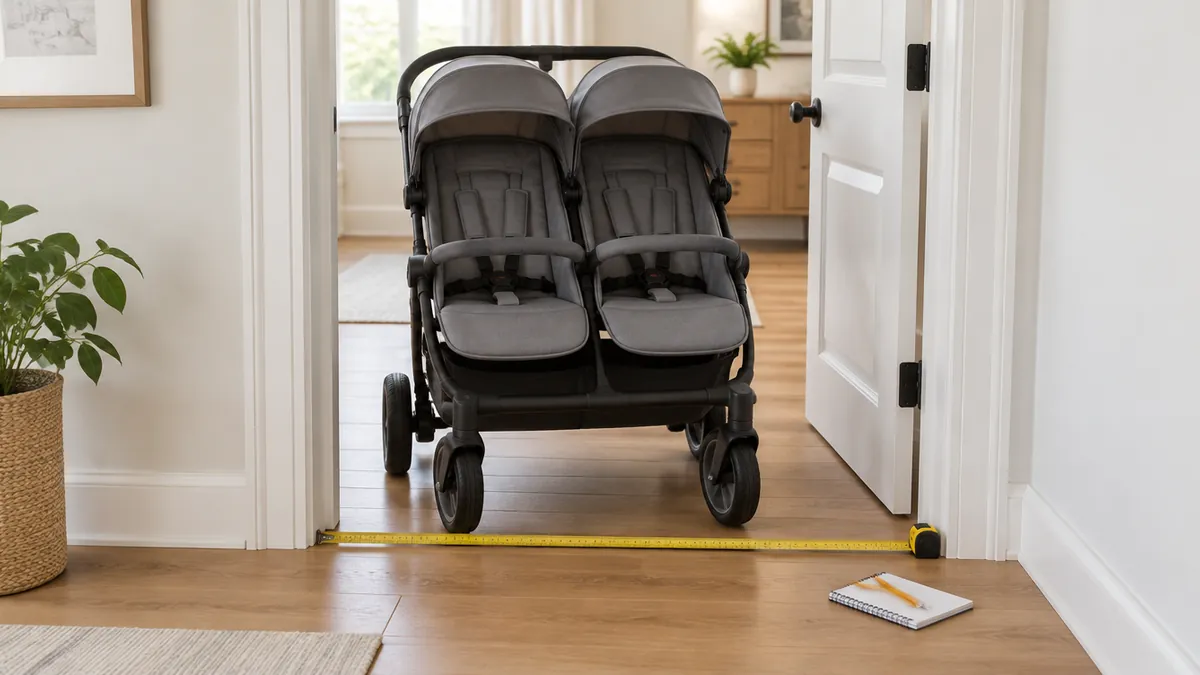
Double stroller buying mistakes mostly start with a number that sounds like an answer and isn’t one, such as a doorway claim or a trunk’s cubic feet. This guide goes through seven of them, each as a mistake, the reason it happens and a fix, using what Baby Jogger, Contours, Mockingbird and the ADA publish.
Table of Contents
Double Stroller Buying Mistakes: The Short List
The seven mistakes below are the ones the pages themselves invite. Each one is a spot where a maker’s wording, a car maker’s spec or a store listing leaves out the number you need. None of them needs a tape measure to understand, but all of them need one to fix.
The pages we read are for strollers that two children can ride, whether side by side or one behind the other. We picked the Baby Jogger pages because they list dimensions in a table. Other makers’ pages differ, and the habit of checking what a page leaves out matters more than any single stroller.
Researched: the figures come from Baby Jogger’s City Tour 2 Double page and City Mini GT2 Double page, read in October 2026, and from the makers’ pages linked below. We haven’t used any of these strollers, and the arithmetic is ours.
Mistake 1: Trusting “Fits a Standard Doorway”
Why it happens: Baby Jogger’s pages say both the City Tour 2 Double and the City Mini GT2 Double fit through a standard doorway, and the line is easy to read as a promise about your door. Neither page says what width it counts as standard. The listed widths are 26.1 inches and 29.25 inches, a gap of 3.15 inches, per the official specs.
What to do: measure your own doors. The ADA’s 2010 design standards describe a doorway’s clear width as the opening between the face of the door and the stop when the door is open, and set a minimum of 32 inches for accessible doorways, per the ADA design standards. Your door may be narrower, so measure it before you compare it with any listed width.
Measure every door on the route, not only the front one: the nursery, the bathroom, the garage entry and any elevator you use. The narrowest one sets the limit, and a stroller that clears the front door can still stall in a hallway.
Mistake 2: Reading Unlabeled Dimensions as Folded Size
Why it happens: a table of width, height and depth looks like the size you’ll carry. For the City Tour 2 Double, Baby Jogger lists 26.1, 40.3 and 37.2 inches, and for the City Mini GT2 Double 29.25, 42.25 and 40.7 inches. Neither page says whether the stroller is open or folded, and neither lists a folded size. A stroller’s open width and its folded width can differ by a lot.
What to do: look for a line that says folded, and if there isn’t one, ask the maker before you buy. Our side by side vs tandem double stroller guide shows how Mockingbird labels unfolded and folded sizes separately, which is the kind of labeling to look for.
Mistake 3: Judging the Trunk by Cubic Feet
Why it happens: a car maker lists cargo volume in cubic feet, a number that suits groceries and says little about a stroller. A folded frame is long, and the trunk opening or a wheel well can be the limit before the volume is.
What to do: measure the trunk opening and the floor depth, then compare them with the folded size from mistake 2. Our double stroller trunk fit guide covers which dimension tends to limit a side-by-side frame and which a tandem.
Write the numbers down with the date. Trunk measurements are easy to forget and hard to re-take in a store parking lot, and a note on your phone makes the folded size from mistake 2 a one-glance comparison. Check the opening at its narrowest point, the floor depth, and the height under any cargo cover.
Mistake 4: Pricing the Stroller and Forgetting the Rest
Why it happens: the headline price is for the stroller. Contours lists its Element Single to Double at $899.99, and Baby Jogger lists the city select 2 at $659.99 with the second seat, infant car seat and glider board sold separately, as we found in our twin travel system guide. The two listed prices differ by $240.00 before any add-ons, and the add-ons can narrow or widen that gap.
What to do: add up the whole setup you’d need on the day you bring it home: stroller, second seat, adapters and any board. Keep a list of each add-on with its listed price and a link, so you can re-add the total when a price changes. The total is the price to compare, and prices change, so open the current listing and compare it against the numbers above.
Mistake 5: Assuming It Carries Two Infant Car Seats
Why it happens: a double stroller sounds like it takes two infant seats, and some pages don’t say. The City Tour 2 Double page makes no direct statement about car seat compatibility and links a separate compatibility document. A maker’s page may state compatibility only for its own seats.
What to do: find the compatibility list for your infant seat and the adapters your stroller needs, and read it for your exact seat model. If the page doesn’t say, ask the maker, and let the answer decide whether you buy the stroller.
Mistake 6: Choosing Side-by-Side or Tandem by Label
Why it happens: the common rule says side-by-side is wide and tandem is long. The pages don’t always follow it. In our comparison of the two layouts, the City Tour 2 Double lists 26.1 inches and the Mockingbird tandem lists 26 inches, nearly the same, while the City Mini GT2 Double lists 29.25 inches.
What to do: compare models, not layouts. Pick the tight spot you meet most, such as a door, a hallway or an elevator, and check the listed number for it on each stroller you’re considering. A narrow door punishes a wide frame and a tight hallway punishes a long one, and the listed width and depth for each model tell you which applies, if the page says how they were measured. If it doesn’t, that is mistake 2 again.
Mistake 7: Skipping the Convertible Question
Why it happens: a second child feels like a reason to buy a double right away. Some makers sell a stroller that starts as a single and converts later. Mockingbird says its stroller starts as a single and can be converted to a double if your family grows, and Baby Jogger says the city select 2 converts to a double or a triple.
What to do: decide whether you need two seats now or in a few months, then compare the convertible’s total cost with a dedicated double. Our City Select 2 vs Mockingbird guide lines the two convertibles up. Which is cheaper depends on timing, and we don’t give a ruling on it.
What Did the Two Baby Jogger Pages Leave Out?
Reading closely helps, but some answers are simply not on the page. Across the two Baby Jogger double stroller pages we read, these were missing:
- Whether the listed width, height and depth are open or folded.
- Any folded size at all.
- The City Mini GT2 Double’s weight.
- For the City Tour 2 Double, a direct statement about which infant car seats it takes.
A missing number isn’t a flaw in the stroller. It means the page can’t answer that question, and the maker’s customer support or the manual can. Ask before you buy, and keep the reply with your receipt so you have it if the stroller turns out not to fit.
Which Double Stroller Buying Mistake Costs the Most to Fix?
Mistakes 1 to 3 are measuring mistakes, and they are the hardest to fix after the box arrives, because a stroller that doesn’t fit your door or trunk may mean a return. Mistakes 4 and 5 are about what you’d pay for and what you can carry, and they show up at checkout or the first car trip.
Before you buy, check the retailer’s return window. It doesn’t change what you measure, but it limits the damage if a number turns out wrong.
What Should You Check Before You Order?
- Measure each door the stroller must pass through, with the door open, and write down the clear width.
- Find a folded size, or ask the maker for one, and compare it with your trunk’s opening and floor depth.
- Add the second seat, adapters and any board to the stroller price.
- Read the compatibility list for your infant car seat.
- Check whether a convertible would cover the next year.
Most double stroller buying mistakes show up in one of those five checks, and each takes a few minutes. Check your stroller’s manual for how to fold and use it.
By The 4 Kids Dad · Updated October 17, 2026. Parent of 4 kids, including newborn twins.
Leave a Reply