This is general product research, not a substitute for your stroller’s manual. Follow the manufacturer’s instructions for assembly, folding, and use, and keep children clear of the frame while folding or unfolding.
Researched: widths, depths, and weights come from Baby Jogger’s City Tour 2 Double and City Mini GT2 Double pages and Mockingbird’s Single-to-Double 3.0 page, checked October 4, 2026. We haven’t tested these strollers.
Quick Verdict: In a side by side vs tandem double stroller choice, width alone doesn’t decide it. The narrowest side-by-side we checked lists 26.1 inches and the Mockingbird tandem lists 26 inches, while the City Mini GT2 Double lists 29.25. Pick by the tight spot you hit most often: doorways punish width, and hallways, elevators, and tight turns punish length.
Last updated: October 4, 2026
Table of Contents
| Model (layout) | Listed width | Listed height x depth | Listed weight |
|---|---|---|---|
| Baby Jogger City Tour 2 Double (side by side) | 26.1 in | 40.3 in x 37.2 in | 23.21 lb |
| Baby Jogger City Mini GT2 Double (side by side) | 29.25 in | 42.25 in x 40.7 in | Not listed on the page |
| Mockingbird Single-to-Double 3.0 (tandem) | 26 in (widest point) | 40 in x 33 in (front to back wheel) | 28 lb single, 36 lb with two seats |
Baby Jogger’s pages list “Product Width,” “Product Height,” and “Product Depth” without saying whether the stroller is open or folded. Mockingbird lists unfolded and folded sizes separately, and the unfolded numbers are the ones above. The weights are the manufacturers’ figures, and we’ve seen other sources disagree on stroller weights, so check the current listing.
Side by Side vs Tandem Double Stroller: Doors Come First
For most families, the daily question about a side by side vs tandem double stroller is whether it gets through the front door and the doors inside. A side-by-side frame puts two seats next to each other, so width is its built-in limit. A tandem puts one seat behind the other, which usually means a narrower frame and a longer one. To mark a door swing and a clear path with tape, see our twin nursery layout checklist.
The spec pages complicate that tidy rule. The Baby Jogger City Tour 2 Double lists 26.1 inches, which is about the same as the Mockingbird tandem’s 26. Baby Jogger describes the City Tour 2 Double as one that “fits through a standard doorway,” but the page doesn’t say what width it considers standard. The City Mini GT2 Double lists 29.25 inches, so it’s a full 3 inches wider than the other two. The layout matters less than the specific model.
How to Measure a Door for a Double Stroller
A door’s labeled size and the space you can push a stroller through aren’t the same. The ADA’s 2010 design standards define a doorway’s clear width as the opening measured between the face of the door and the stop with the door open 90 degrees. They require at least 32 inches of clear width for accessible doorways in public buildings, and that figure is a handy benchmark here, though it’s a design standard for public buildings, not a rule for your home.
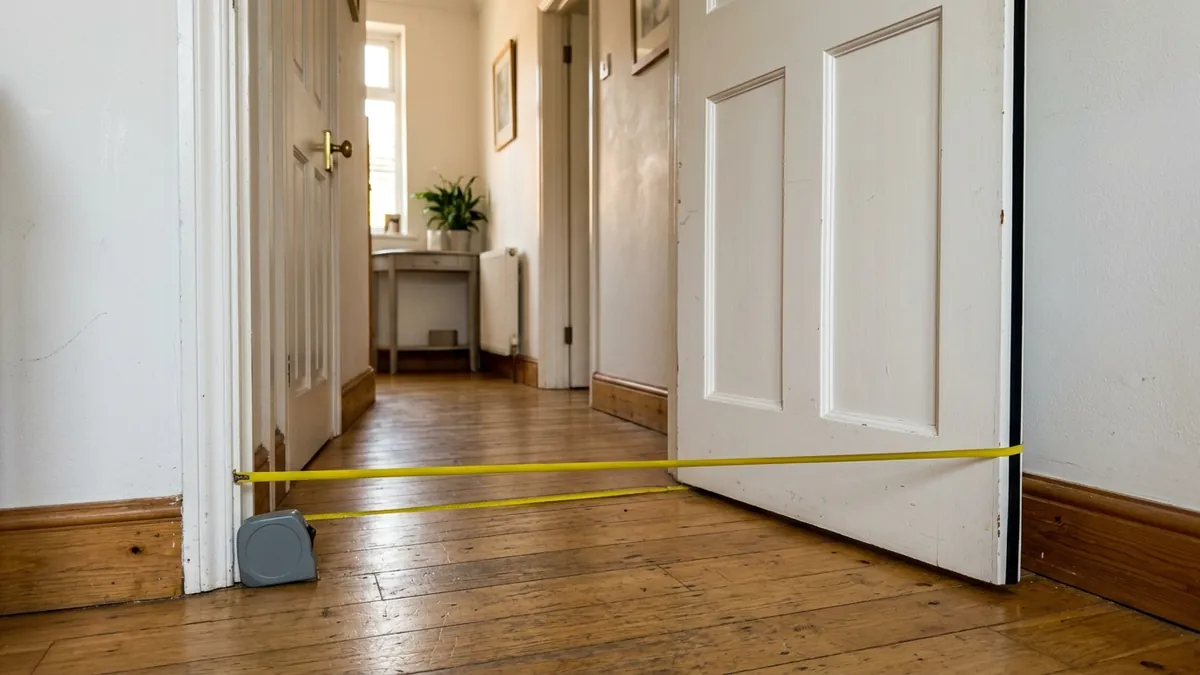
- Open the door fully and measure the clear width. Run a tape from the stop on the frame to the face of the open door at the narrowest point. That’s the number a stroller has to clear.
- Measure every door on your daily route. Front door, a bathroom, a nursery, an apartment hallway door. The narrowest one decides.
- Compare with the stroller’s listed width. That figure is its widest point, which is usually the wheels, handlebar, or seat frames.
- Leave room for your hands. That’s our practical advice, not a manufacturer rule: a stroller that only just clears a door means scraped knuckles and a slow push.
- Check elevators and vestibules separately. They have their own openings, and tandem length matters more there.
Here’s why the measurement matters, using a made-up door. Say a hallway door has 30 inches of clear width once it’s open. The City Mini GT2 Double’s listed 29.25 inches leaves 0.75 inch in total, so you’d be pushing a stroller through with roughly three-eighths of an inch to spare on each side. The City Tour 2 Double’s listed 26.1 inches leaves 3.9 inches in total, and the Mockingbird’s listed 26 inches leaves 4. The door is hypothetical and the arithmetic is ours, but it shows how a stroller that “fits” on paper can still feel like a squeeze in a real hallway.
Pros and Cons of Each Layout
| Layout | Pros | Cons |
|---|---|---|
| Side by side | Both seats sit at the same position, so neither child is looking at the back of the other’s seat. Length stays shorter than a tandem with both seats in use. | Width is the built-in limit at doors. The listed widths above range from 26.1 to 29.25 inches. |
| Tandem | A narrower frame is possible, since the seats stack front to back. The Mockingbird lists 26 inches unfolded. | The stroller gets longer with the second seat attached, and the manufacturer pages we read don’t list a double-mode length. |
These pros and cons describe how the layouts work in general. The numbers come from the manufacturer pages above, and the rest is our reasoning.
Turns, Hallways, and Elevators
This is where a tandem pays for its narrow frame. Because the second seat sits behind the first, the whole stroller is longer, which matters in hallways with a turn, small elevators, and tight store aisles. Mockingbird’s page lists 33 inches front to back wheel, but it doesn’t say whether that includes the second seat, so measure a tandem in the configuration you’ll use before you rely on that figure.
A side by side is the opposite: it turns more compactly but needs a wider door. If your biggest pinch point is an apartment entry or a narrow hallway door, width is your bottleneck. If it’s an elevator or a corner, length is.
What Each Model’s Page Highlights
The City Tour 2 Double is the lightest of the three at a listed 23.21 pounds, and Baby Jogger describes its fold as ultra-compact, with a one-step action and auto-lock. The City Mini GT2 Double lists the largest dimensions of the group, 42.25 inches high and 40.7 inches deep, and its page describes a patented one-step quick-fold. Mockingbird’s page lists a height-adjustable canopy and gives separate unfolded and folded dimensions. Its Single-to-Double design starts as a single stroller, which is why the weight list has both a single and a double figure.
That’s a small sample, and it’s limited to the models whose official pages we could read. A side by side vs tandem double stroller choice has dozens of other models in it, and their widths vary the same way. Use these three as examples of the range, not as a ranking.
Which Layout Fits Which Situation
These are our reasoning, based on the listed numbers and how each layout works, not manufacturer guidance.
- Narrow apartment or condo doors: look for the smallest listed width first. In this sample that’s the Mockingbird at 26 inches or the City Tour 2 Double at 26.1, then measure your door’s clear width as described above.
- Small elevators or sharp hallway turns: a side by side’s shorter length may be easier to turn, but compare the listed depth of the specific model before assuming.
- Mostly one child at a time: a single-to-double design like the Mockingbird starts as a single stroller, so you attach the second seat only when you need it.
- Frequent car trips: folded size decides this. Our trunk fit guide has the folded dimensions we could confirm.
The ADA’s clear-width rule is a useful reminder of why low obstacles matter at a door. It says no projection into the required clear opening is allowed below 34 inches above the floor, and that’s exactly the zone where a stroller’s wheels and frame sit. In your own doorway, hinges, door stops, and thresholds eat into that same low space, so measure the narrowest point rather than the opening between the jambs.
Daily Handling and Where Each Stroller Goes Next
For how a tandem actually handles with both children in it, including weight, curbs, and the second seat, see our City Select 2 vs Mockingbird comparison. For the folded sizes that matter once the stroller goes into a car, see our double stroller trunk fit guide.
Side-by-Side vs Tandem Strollers: Before You Buy
Who it’s for: Parents choosing between layouts who’ve measured the doors on their daily route and know whether width or length is the tighter limit.
Who should skip: Anyone who hasn’t measured their doors yet, and anyone choosing based on layout alone without comparing the specific model’s listed width.
Where to buy: The manufacturer’s site or a major baby retailer with a clear return window. Check the current listing for price and return terms.
Alternative: A single-to-double stroller that starts as a single, or a lightweight double you only use when both children need it. Check the current listing for the exact model’s dimensions.
This post may contain affiliate links. If you purchase through one of these links, we may earn a small commission at no extra cost to you.
Written by The 4 Kids Dad, parent of 4 kids including newborn twins.
Leave a Reply