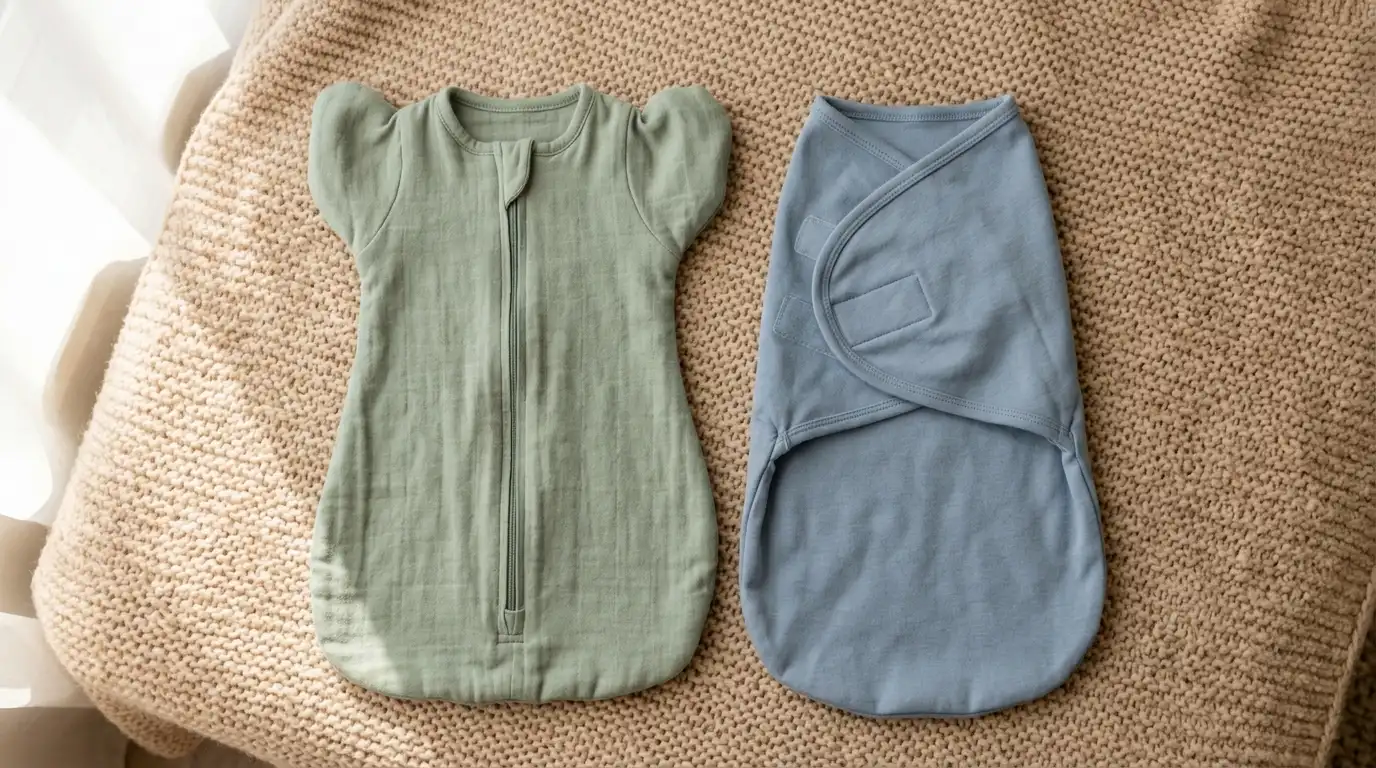
By month three, the Swaddle Up was folded at the bottom of a drawer, and I’d already ordered a HALO SleepSack Swaddle as backup. That is not the ending I expected when I tore open the first pack in the middle of hospital-bag chaos, week one, with two newborns and zero idea what I was doing. This Love to Dream vs HALO SleepSack Swaddle comparison covers exactly what changed between those two points.
This post may contain affiliate links. If you make a purchase through these links, we may earn a commission at no extra cost to you.
Last updated: September 21, 2026
This is general information based on common parenting practices, not medical advice. For any concerns specific to your baby, talk to your pediatrician.
Quick Verdict: Love to Dream Swaddle Up won the first six weeks — mostly because of the zipper. HALO SleepSack Swaddle won the stretch after that, once one twin started fighting to get her arms out.
Direct answer: For newborns who fight the startle reflex, a zip-up bamboo-blend swaddle like Love to Dream Swaddle Up tends to be easier to manage in the first few weeks — the two-way zipper speeds up night diaper changes. Once a baby gets closer to rolling, an adjustable option like the HALO SleepSack Swaddle makes the arms-out transition more gradual.
Table of Contents
First Impressions: Why the Zip-Up Won Me Over
Back up to week one. We’d registered for the cotton version of the Swaddle Up, gotten gifted the bamboo-viscose one instead, and honestly didn’t think it would matter.
It mattered.
The fabric — 95% viscose from bamboo, 5% spandex per the Love to Dream listing — felt cool and a little slippery against skin, nothing like the slightly stiffer cotton version we tried a few weeks later. My wife noticed it before I did. She held it up, rubbed it between two fingers, and said it felt more like a t-shirt than a blanket.
The two-way zipper was the real win, though. At 3 a.m., with a diaper to change and a baby already unhappy about being woken up, being able to unzip from the bottom without fully opening the swaddle saved real time. Multiply that by two babies, multiple times a night, and it adds up fast.
The arms-up design was the other selling point — Love to Dream markets it as helping with the startle reflex, and for one of our twins, that tracked. She settled faster with her arms up near her face. Her sister could not have cared less either way.
Which — fine. Not every feature works for every baby. We knew that going in.
What Changed After Three Months of Twin Newborn Chaos
Here’s the part most swaddle reviews skip entirely: what happens after the newborn stage.
Around week six, both twins started gaining weight faster than their swaddle size did. The bamboo-viscose fabric has more give than cotton, which is great for comfort and less great for containment once a baby is a few pounds past “newborn.” One night I found an arm out of the neckline — not dangerous, just enough to notice — and that became the moment we started doing a second check before bed instead of trusting the zip alone.
I want to be honest about that, because I almost left it out of this post.
By week eight, one twin was reliably breaking free of the arms-up position anyway, which — depending on who you ask — is either a sign the swaddle isn’t working or a sign the baby is ready to move on from swaddling altogether. We took it as the second one.
Pro-tip: If you’re between sizes, size up early rather than late. A slightly loose zip-up swaddle is more of a hip-room issue than a safety one, but a too-tight one is worse for both.
Where the Love to Dream Held Up
| Pros | Cons |
|---|---|
| Two-way zip made one-handed diaper changes fast, even half-asleep | Bamboo-viscose stretch meant sizing up sooner than the cotton version would have needed |
| Arms-up position noticeably calmed the startle reflex for one of our twins | No built-in way to transition to arms-out — it’s swaddle or nothing, not a gradual step-down |
| Fabric stayed soft and didn’t pill after repeated washes |
Why We Started Looking at the HALO Instead
We hadn’t owned a HALO SleepSack Swaddle at the time I’m writing this update, so everything here comes from the manufacturer’s current product listings and specs rather than our own nights with it — I want to be upfront about that distinction.
The HALO’s pitch is a three-way adjustable design: arms-in, one-arm-out, or two-arms-out, using adjustable wings over a double zipper. According to the manufacturer’s current listing, that’s built specifically for the transition period we were hitting around month two — instead of switching products outright, you loosen the same one gradually.
That’s not even the part most comparison posts get wrong. The bigger difference isn’t the closure — it’s that HALO sells the same swaddle across a wider TOG range, so the “which one for which season” question mostly disappears once you’re set up with it.
What the Research Says About the HALO
| Pros | Cons |
|---|---|
| Three-way adjustable design allows a gradual arms-out transition, per the product description | Adjustable wings add a step on top of the zipper — not something we’ve timed ourselves |
| Available across a wide TOG range (roughly 0.5 to 3.0 per current listings) for different room temperatures | The bamboo-viscose version of the HALO is priced noticeably above its own cotton version |
| Verified by the Baby Safety Alliance (formerly JPMA) according to the manufacturer |
Love to Dream vs HALO SleepSack Swaddle: Side-by-Side
| Feature | Love to Dream Swaddle Up (bamboo-viscose) | HALO SleepSack Swaddle |
|---|---|---|
| Closure | Two-way zipper | Double zipper plus adjustable wings |
| Arms position | Arms-up only (transition version exists separately) | Arms-in / one-arm-out / two-arms-out in one product |
| Fabric (per current listing) | 95% viscose from bamboo, 5% spandex | 100% cotton (bamboo-viscose version also sold separately) |
| TOG options | Mainly 1.0 TOG for this fabric line | Roughly 0.5–3.0 TOG across the lineup |
| Price range (check current listing) | Generally mid-range for this category | Slightly higher for the bamboo-viscose version |
| Best for | Newborns fighting the startle reflex who need fast night changes | Babies mid-transition out of swaddling, or families wanting one product across seasons |
Final Verdict: What We’d Actually Buy Again
If I were doing week one again, I’d still start with the Love to Dream Swaddle Up. The zipper alone justified it for us, twice over with two babies. But I wouldn’t buy a second one for the stretch after week six — that’s where the HALO’s adjustable design looks like the better fit on paper, and it’s what we’re trying next.
So: in a Love to Dream vs HALO SleepSack Swaddle decision, if you’re setting up before birth or in the very first weeks, the zip-up bamboo option is worth checking out. If your baby is already a couple months in and pushing back against a full swaddle, look at the HALO SleepSack Swaddle’s current listing for the TOG and size that fits your season before deciding.
How We Researched This
Personally tested: Love to Dream Swaddle Up · Researched: HALO SleepSack Swaddle. Firsthand notes come from three months of daily use of the Love to Dream Swaddle Up with newborn twins. HALO SleepSack Swaddle details were cross-checked against the manufacturer’s current product listings and specification pages rather than hands-on use, and that distinction is called out wherever it applies above.
If you’re also deciding how to keep an eye on the nursery overnight, our video vs audio baby monitor comparison breaks down that choice.
Written by Four Kids Dad, parent of four kids including newborn twins. More about our family and how we test products is on the About page.
Leave a Reply