If you need to buckle car seats too close together, the problem usually isn’t strength — it’s sequence. Car seats can technically sit side by side on a bench and still make every departure a fight: hands scraped against hard plastic shells, buckles buried under flared bases, a five-minute errand turning into a wrestling match before anyone’s even strapped in.
This post may contain affiliate links. If you make a purchase through these links, we may earn a commission at no extra cost to you.
Last updated: September 20, 2026
Quick Verdict: Harnessed car seats and boosters need completely different approaches. A harnessed seat only needs the vehicle belt buckled once, during installation. A booster needs it buckled every single trip — so the fix has to work for daily use, not just setup.
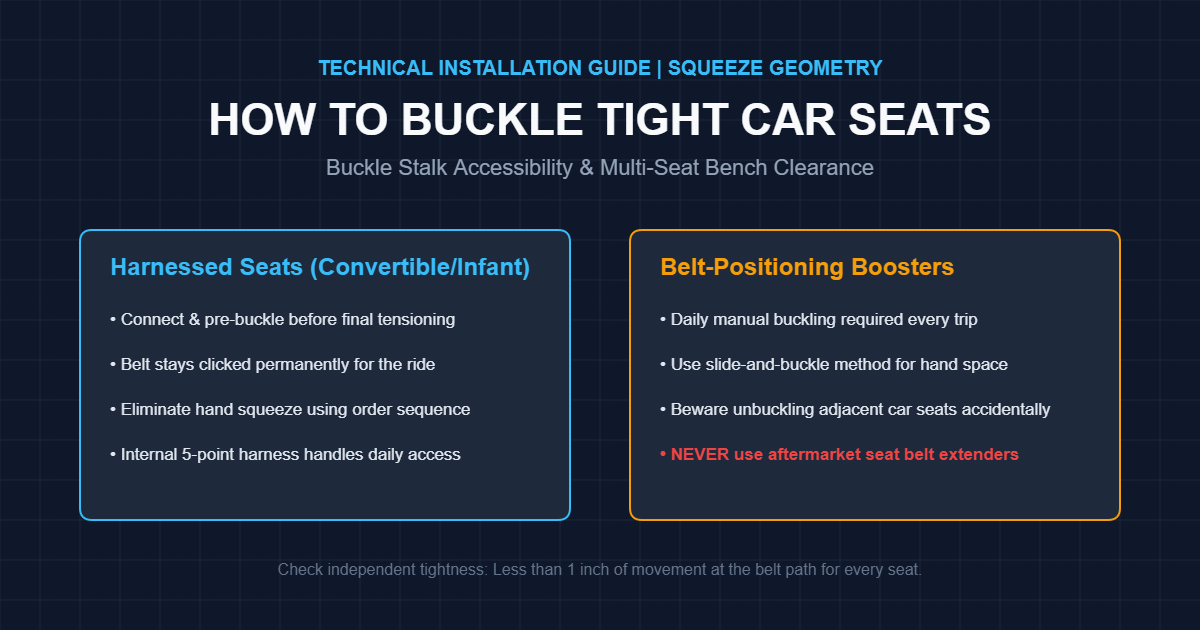
Direct answer: To buckle car seats too close together, pre-route and click the vehicle belt into harnessed seats before pulling them fully into position and tightening — that connection then stays put, since the child rides secured by the seat’s own harness. For boosters, which need the belt rebuckled every trip, choose a narrow-base model and slide it slightly outboard to buckle before sliding it back into place. Never use an aftermarket seat belt extender to solve buckle access on either type.
Table of Contents
Why Buckles Disappear in the First Place
Seat belts don’t anchor at the outer edges of a bench — they emerge from a fixed point called the seat bight, where the cushion meets the seatback. In a standard 60/40 split bench, the center buckle and one outboard buckle often sit close together. When two car seats go in side by side, their lower plastic bases can cover that bight area completely, burying the buckle receiver underneath — which is exactly why so many parents end up needing to buckle car seats too close together in the first place.
It’s tempting to assume that if you can physically wedge a hand between two seats to click a buckle, the setup works. That’s not quite the right test. A car seat positioned directly over an adjacent buckle stalk can risk accidental unbuckling during driving, or put uneven pressure on the seat that goes against the installation instructions — so the goal isn’t just “can I reach it,” it’s “does the buckle sit clear of both seats.”
Harnessed Seats: The Pre-Routing Sequence to Buckle Car Seats Too Close Together
If you’re struggling to buckle a 5-point harness convertible or infant seat because a neighboring seat is already installed, the usual problem is the order of operations — trying to thread a buckle after both seats are already compressed into the cushions is nearly impossible.
| Step | What to Do |
|---|---|
| 1. Position loosely | Place the car seat in its spot without shoving it fully against the seatback yet |
| 2. Route and click first | Thread the vehicle belt through the correct belt path and click it into the buckle while you still have room to see it |
| 3. Eliminate slack | Shift the seat into its final position and pull the lap belt tight |
| 4. Compress and lock off | Push down and back into the cushion while feeding remaining slack into the retractor or engaging the seat’s lock-off |
| 5. Test independent tightness | Grab the seat at the belt path and check it moves less than one inch in any direction, and that the buckle isn’t resting on a hard plastic edge |
There’s no single universal order for which seat to install first in a 3-across row — it depends on the vehicle. In benches where the center position partially overlaps an outboard buckle, clicking and routing the outboard belt before tightening the center seat tends to avoid trapping the buckle underneath.
Boosters: A Problem That Doesn’t Go Away After Installation
A harnessed seat only needs the vehicle belt buckled once. A booster is different — it uses the lap-and-shoulder belt directly across the child’s body, which means buckling on every single trip. When a booster sits within an inch or two of a neighboring seat, that daily buckling becomes the actual recurring problem, not a one-time setup hurdle.
Two things worth watching for when you need to buckle car seats too close together with a booster in the mix:
Accidental neighbor unbuckling: a child reaching blindly into a narrow gap can press the release button on an adjacent harnessed seat instead of their own buckle. Check all buckles before driving, or teach older kids exactly which one is theirs.
The slide-and-buckle method: if a hand won’t fit beside the booster base, have the child sit on the booster, slide the booster a couple of inches toward the open door, buckle the visible belt, then slide the booster back into its aligned position, checking the belt stays flat and untwisted.
Why Seat Belt Extenders Aren’t the Fix
When buckles are hard to reach, aftermarket seat belt extenders look like an obvious shortcut — plug in a rigid or flexible stalk to raise the buckle above the car seat base. Vehicle manufacturers and child safety organizations generally advise against this for child restraints, and for a specific reason: extenders aren’t crash-tested with car seats and boosters, and they can shift how the lap belt sits — moving it up from the pelvis toward the soft abdomen instead of resting on the hip bones, and adding slack that keeps the retractor from locking down properly. The safer route is solving the geometry problem directly — pre-routing, repositioning, or choosing a narrower seat — rather than working around it with an unrated accessory.
Frequently Asked Questions
Is it safe for car seats to touch each other?
Generally yes, as long as neither seat is being displaced, tilted, or distorted by the other, and each one passes an independent tightness check on its own — under one inch of movement at the belt path.
Why won’t my infant seat’s carrier release next to another seat?
Infant carriers need clearance on both sides to release from their base, and models with wide dual-release handles can bind against an adjacent seat shell. A narrower, single-hand-release carrier tends to have less friction in tight rows.
Final Verdict
The fastest way to buckle car seats too close together is to work with the vehicle’s geometry rather than forcing parts together. For harnessed seats, solve it once with the pre-routing sequence above. For boosters, plan for the slide-and-buckle method every trip rather than expecting a one-time fix. If buckles stay buried no matter what you try, a certified Child Passenger Safety Technician can look at your specific bench layout and suggest a seating arrangement that actually works.
How We Researched This
Researched: This guide reflects general child passenger safety practice around belt routing, buckle geometry, and manufacturer guidance against seat belt extenders with child restraints, rather than a test of any single vehicle. Always check your specific vehicle and car seat manuals, since buckle stalk design varies by model.
For the bigger layout question, see our guides to fitting three car seats across a sedan and two rotating car seats in captain’s chairs.
Buckle access is step four of our larger 3 car seats across plan, which starts with measuring the row.
Written by Four Kids Dad, parent of four kids including newborn twins. More about our family and how we research topics for this blog is on the About page.
Leave a Reply