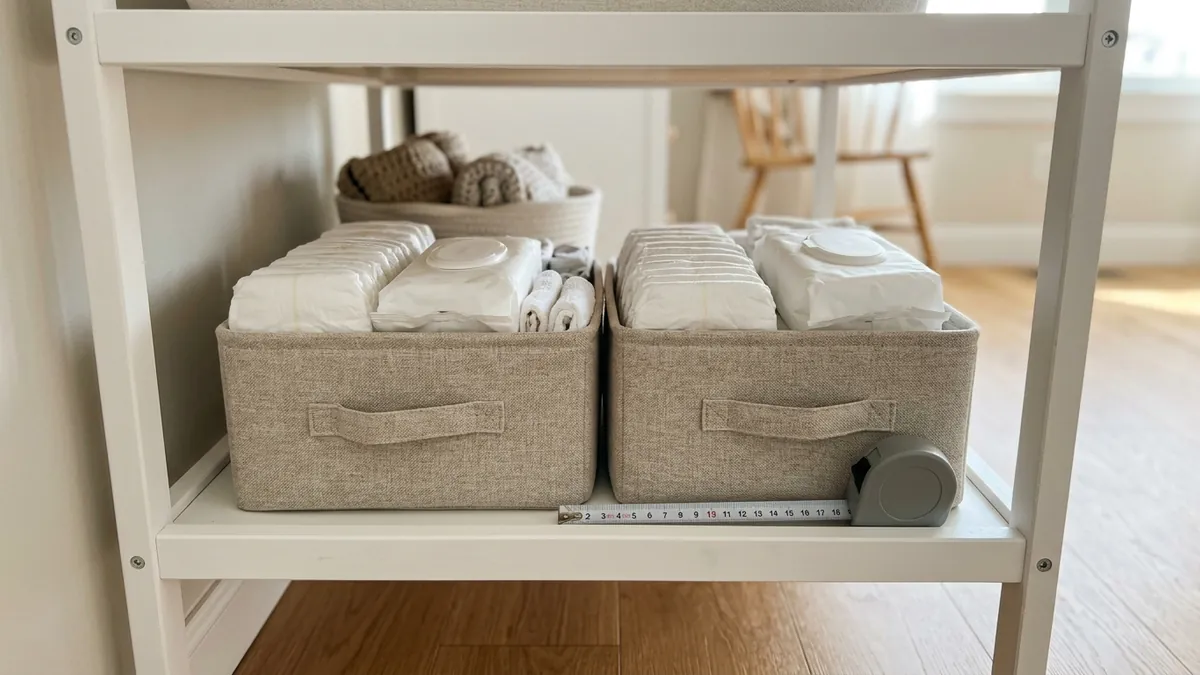
Two of the four diaper caddies we checked list exactly the same size, 13 by 9 by 7 inches, yet one is listed at $23 and the other at $30. A third is a different shape at 15 by 9.5 by 8.5 inches, and it’s the only one with a light built into the handle. That’s the real shopping problem with a diaper caddy for changing table use: the sizes look interchangeable until you hold them up against your own shelf.
We read the manufacturer pages for Parker Baby Co. and Skip Hop and compared what they list. We couldn’t confirm sizes for other brands’ caddies on official pages, so they’re not here. If you have twins, the question we kept asking is whether two of the same caddy fit on one shelf, and we worked that out below.
Researched: sizes, features, and prices come from Parker Baby’s Felt Diaper Caddy and Rope Diaper Caddy pages and Skip Hop’s Nursery Style Light-Up Diaper Caddy page on its parent company Carter’s, checked October 5, 2026 (official spec). We haven’t used any of them, so none is personally tested. Our order is editorial, based on listed price and features, not a performance test.
| Our pick | Listed size (official spec) | Listed features | Listed price |
|---|---|---|---|
| 1. Parker Baby Felt Diaper Caddy, Regular | 13 x 9 x 7 in | Eight exterior pockets, removable insert, long handles | $23.00 |
| 2. Parker Baby Rope Diaper Caddy | 13 x 9 x 7 in | Three main compartments, washable build, long handles | $30.00 |
| 3. Skip Hop Nursery Style Light-Up Diaper Caddy | 15 x 9.5 x 8.5 in | Touch light on the handle, modular divider, four pockets | $45.00 |
| 4. Parker Baby Felt Diaper Caddy, Large | 16 x 10 x 7 in | Same felt design as the Regular | Price not read separately |
Table of Contents
Is a Diaper Caddy for Changing Table Setups Worth It With Twins?
A caddy makes a changing table more useful in one specific way: it lets you carry the supplies instead of the baby. With twins, that matters more, because you may change them in two rooms or at two moments in a row and want the same set of supplies in both places. That’s our reasoning from how caddies work, not something the manufacturers claim.
The trade-off is shelf space. A diaper caddy for changing table shelves takes up the same room whether it’s full or empty, and a caddy that lives on a changing table shelf takes up the same room whether it’s full or empty, so the size on the product page is worth checking before you fall for the look. For a related nursery decision, our Ubbi vs Dekor Plus diaper pail comparison covers the other bulky item that tends to land near the changing table.
How Big Is Each Caddy, Really?
The manufacturers list outside dimensions as length by width by height. Multiplying them gives an outer volume, which is a rough size comparison rather than a usable-capacity figure, since the walls, dividers, and pockets all take space. The arithmetic below is ours.
| Caddy | Listed L x W x H (in) | Formula | Outer volume (on paper) |
|---|---|---|---|
| Parker Felt, Regular | 13 x 9 x 7 | 13 × 9 × 7 | 819 cu in |
| Parker Rope | 13 x 9 x 7 | 13 × 9 × 7 | 819 cu in |
| Skip Hop Light-Up | 15 x 9.5 x 8.5 | 15 × 9.5 × 8.5 | 1,211 cu in |
| Parker Felt, Large | 16 x 10 x 7 | 16 × 10 × 7 | 1,120 cu in |
The Skip Hop is the biggest by volume even though the Parker Large is the longest, because the Skip Hop is also the tallest at 8.5 inches. That height can matter if your changing table has a low shelf above the caddy’s spot.
Can Two Caddies Share One Shelf? A Twin Math Check
This is a made-up shelf, so treat the result as a template and not a prediction. Say a changing table shelf measures 30 inches wide and 12 inches deep. Two caddies end to end have to fit in that width, and each one’s width has to fit in that depth.
| Caddy | Two end to end | Spare on a 30 in shelf (on paper) | Spare on a 12 in depth |
|---|---|---|---|
| Parker Felt, Regular | 26 in | 4 in | 3 in |
| Parker Rope | 26 in | 4 in | 3 in |
| Skip Hop Light-Up | 30 in | 0 in | 2.5 in |
| Parker Felt, Large | 32 in | −2 in (doesn’t fit) | 2 in |
On this shelf, the two 13-inch Parker caddies fit with room to spare, the Skip Hop pair fits exactly with nothing left over, and the Large pair doesn’t fit at all. A real shelf has brackets, lips, and uneven edges, so a zero-inch margin on paper is a problem in practice.
Measure your own shelf before you buy: the width between the side panels, the depth from the front lip to the back, and the height of any shelf or drawer above it. Then run the same subtraction with the numbers above.
Choose or Skip: Four Caddies, One Line Each
Parker Baby Felt Diaper Caddy, Regular
Choose it if you want the lowest listed price and the most exterior pockets, eight according to Parker Baby’s page, plus a removable insert. Skip it if you want a light for night changes or a bigger interior.
Parker Baby Rope Diaper Caddy
Choose it if you like fixed compartments and a washable build; the page lists three main compartments and says to machine wash cold on delicate and line-dry. It’s made of polyester wrapped in cotton yarn with a poly and cotton lining. Skip it if you want a removable insert or exterior pockets, which the page doesn’t list.
Skip Hop Nursery Style Light-Up Diaper Caddy
Choose it if you do night changes and want light without turning on a lamp. Skip Hop says the handle has a touch-sensitive light with a 10-minute auto-off, and the caddy has a movable divider, two elastic mesh interior pockets, and two exterior pockets. Skip it if shelf width is tight, since it’s the biggest in height and has the least spare room in our twin math.
Parker Baby Felt Diaper Caddy, Large
Choose it if you have a wide shelf and want the longest footprint of the four, at 16 by 10 by 7 inches. Skip it if you plan on two of them side by side on a shelf under 32 inches.
What Goes in a Caddy When There Are Two Babies?
A diaper caddy for changing table duty is only as useful as what’s in it, and the layouts on these four pages suggest different ways to organize it. This section is our reasoning from the listed features, not a tested setup.
- Separate by job, not by baby. The Skip Hop’s movable divider and four pockets, and the Parker Felt’s eight exterior pockets, both lend themselves to grouping by task: diapers in the main space, wipes and creams in pockets, small items you grab with one hand in the outer pockets.
- Keep one fixed home for each item. The Parker Rope’s three main compartments work the same way: one for diapers, one for wipes, one for everything else. If you reach for the same pocket every time, you can do a change in the dark without looking.
- Stock two caddies the same way. If you buy a matching pair for twins, load them identically. Then a change at either station needs no thought about which caddy has what.
- Leave some room. A caddy that’s packed to the brim is harder to carry and harder to dig through. The listed sizes are outside measurements, so the usable space is smaller than the outer volume in our table.
None of this changes the numbers on the product pages. It’s just a way to decide which of the four layouts suits how you’d use it.
Shelf, Floor, or Hanging: Where the Caddy Actually Lives
Most people picture a caddy sitting on a changing table shelf, and our shelf math assumes that. But the listed handles on all four suggest a second use: carrying it from room to room. Parker Baby lists long, sturdy handles, and Skip Hop describes its caddy as easy to carry from room to room.
That gives you three ways to place a diaper caddy for changing table setups:
- On the shelf: the simplest option, and the one where width matters. Use the twin math table above to check whether two fit.
- On the floor near a chair or glider: useful if the changing table is in another room, but it takes floor space and sits within a crawling baby’s reach later on.
- Carried between stations: the handle does the work here, so a lighter caddy is easier to move. The pages don’t list weights, so we can’t compare that.
If shelf width rules out two caddies, one caddy plus a basket you already own is a reasonable fallback. It avoids buying a second caddy for a shelf that can’t hold it.
What Each Price Tier Buys
Prices below are as listed on each maker’s page on October 5, 2026, and they change, so check the current listing before you buy.
- Under $25: the Parker Felt Regular at $23.00, with the most exterior pockets listed.
- Around $30: the Parker Rope at $30.00, for fixed compartments and a washable build.
- $40 and up: the Skip Hop Light-Up at $45.00, the only one here with a built-in light.
Buying two of the Regular for twins comes to $46.00 at the listed price, about the cost of a single Skip Hop. That’s simple arithmetic from the listed prices, not a recommendation.
Three Questions Worth Asking First
Do all four have handles?
Yes, according to the pages. Parker Baby lists long, sturdy handles on both its Felt and Rope caddies, and Skip Hop lists an easy-grip handle on its Light-Up caddy.
Which one can go in the washing machine?
The Parker Rope page says to machine wash cold on delicate with like items only and to line-dry. We didn’t read care instructions for the Felt or the Skip Hop, so check those pages before you assume.
Does the light stay on all night?
Not on the Skip Hop. It lists a 10-minute auto-off for the touch-sensitive light.
Your Next Step
Who it’s for: Parents who want supplies within reach of the changing table, especially twin parents who’d like a matching caddy for each station.
Who should skip: Anyone who hasn’t measured their shelf, and anyone who wants proof that one of these holds up better day to day. We haven’t tested them.
Where to buy: The manufacturer’s site or a major baby retailer with a clear return window. Check the current listing for price and return terms.
Alternative: A hanging organizer or a basket you already own, which skips the shelf-width problem. See our twin split-screen monitor guide for another piece of a twin changing and nursery setup. To plan where the changing station sits in the room, see our twin nursery layout checklist.
This post may contain affiliate links. If you purchase through one of these links, we may earn a small commission at no extra cost to you.
By The 4 Kids Dad · Updated October 5, 2026. Parent of 4 kids, including newborn twins.
Leave a Reply